Project-based learning leads to community changes
By Aubrey Ann Parker
Current Editor
Students in the 5th grade at Frankfort Elementary School are beginning to see the fruits of their labor come to fruition—in some cases, quite literally.
Beginning in October, a group of eight students has been identifying ways that they could use their research and math skills to create change in their community—at school, at home, and out in the public—with hands-on projects such as composting, gardening, and building houses for both bats and birds.
There are eight students from both 5th grade classes who were assigned to this “Wonder Woman” power half-hour group: Brixton, Cora, Harper, Maggie, Maverick, Noah, Rebecca, and Sophia.
Twice a day, all students at Frankfort Elementary have what is called a “power half-hour”—these are intervention blocks that are utilized for English language arts (ELA) in the morning and mathematics in the afternoon. In place for the past five years, power half-hours give all students a little something extra, in a way that is tailored to them, based on their test scores.
“During power half-hours, we give kids remediation, if they need it; this is when our students get their Title I* time, if they qualify for it,” says Anne Gwaltney, principal at Frankfort Elementary School. “Instead of pulling those students out of class for these services, [power half-hour] is a way to have everyone in the classroom working on what they need to be working on, specifically. For [the Wonder Woman] group, this is enrichment time, and it’s pretty student-driven work, in the form of these community projects.”
For the morning power half-hour, these eight students work with Emma Kelly, an educational aid for the past two years and notably a 2018 graduate of Frankfort-Elberta Area Schools (FEAS) herself.
For the afternoon power half-hour, students work with Kelly and Michael Tarkington (67), who retired from accounting and finance in private equity real estate about five years ago and moved to Frankfort full time, though his family has been vacationing in this area since the summer after he was born.
Tarkington has been volunteering his time at the elementary school for the past three school years: during both the 2023-24 and 2024-25 school years, he worked with 2nd grade students who had higher math scores. For the 2025-26 school year, Tarkington moved up with last year’s students to 3rd grade math, but he also took on a new challenge of working with the Wonder Woman 5th graders.
“In total, I’m there about eight hours per week,” Tarkington says. “And about one-third of that is with the 5th graders.”
The first step was for the students to come up with a list of ideas of projects they wanted to work on for the school year, with the only requirement from their teachers—Renee Myers and Suzanne Shermack—being that the projects needed to benefit the community in some way.
“These projects had to be something that would force them to do research, do work with a group, and come up with tangible results,” Tarkington says of the criteria. “I wish I could remember all of the kids’ suggestions—we had to pare it down to what was reasonable. But all of these suggestions came directly from the kids.”
During the FEAS school board meeting on Monday, March 9, 2026, these students and their mentors gave a presentation of their accomplishments so far this year.
“When my sister [Rebecca] and I first moved to this school, we came from a school that had composting, so we were really enthusiastic about that,” Maggie told the school board. “We saw how much trash there was here, and we really wanted to change that. So did everyone else.”
Maggie continued:
“The compost process is: we have our fruits and veggies, which turn into leftovers, because not everyone likes to eat their broccoli. That gets broken down by worms and other decomposers, which turns it into the beautiful soil that we love and use in our gardens. Then the process repeats.”
Many considerations had to be fully researched and discussed by the group before decisions could be made and the hands-on work could begin; for instance, citrus can be put in a barrel compost but generally is not advised in a pile compost, because a pile relies heavily on worms for decomposition, and the citrus can shift the pH in a way that is not healthy for the worms.
Ultimately, however, a pile was chosen over a barrel, because a pile is “less space limiting,” according to Maggie.
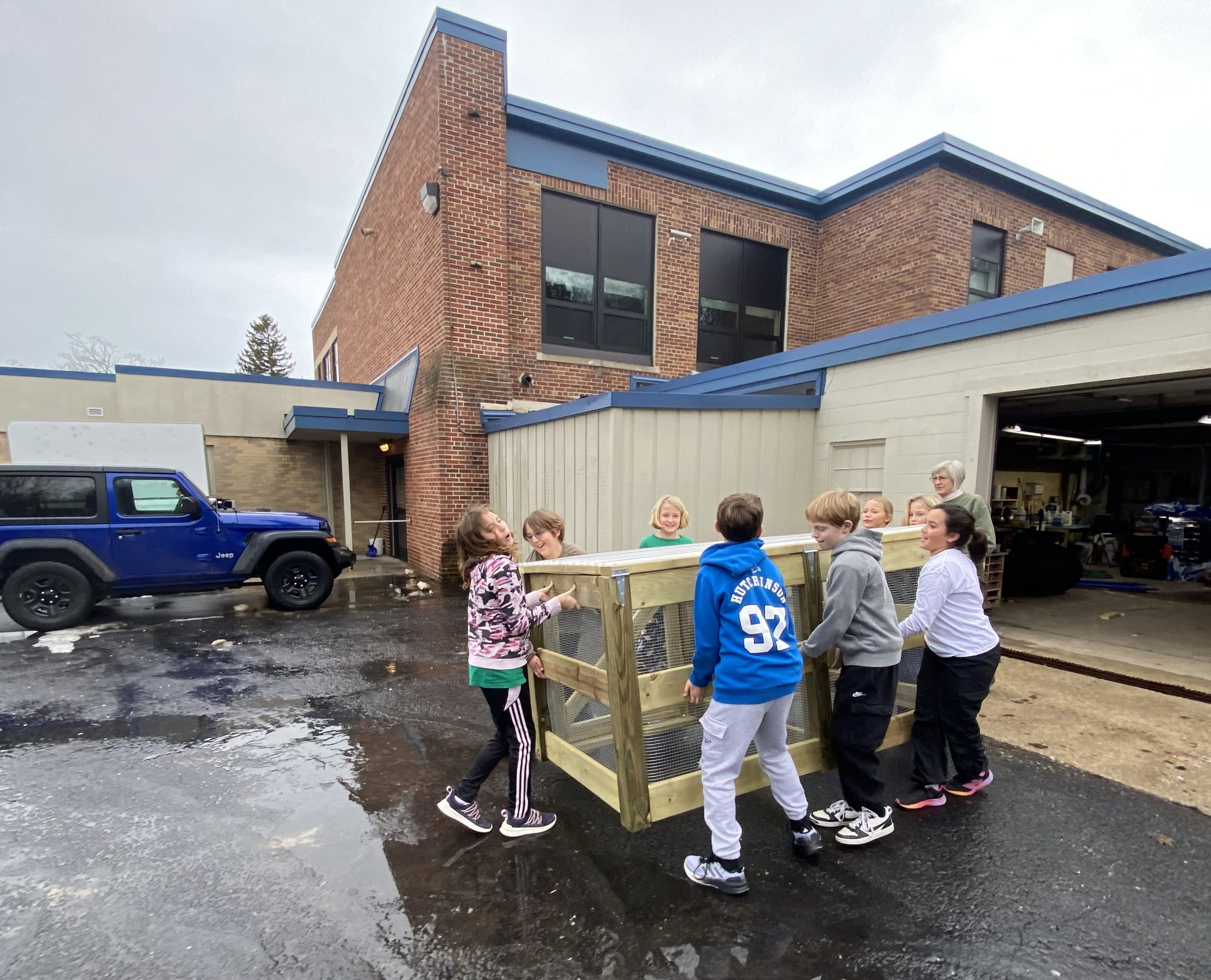
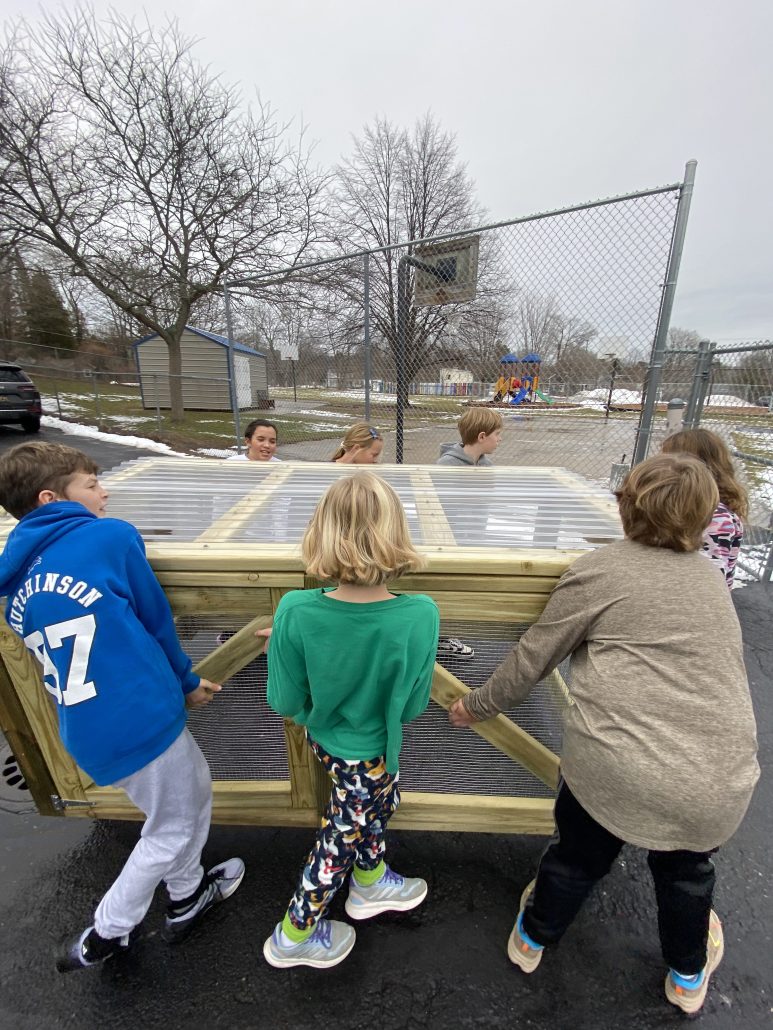
In December, the group began building their compost bin, complete with tool tutorials and safety precautions. Still, the project was not without a few hiccups.
“A problem was that the screws went through the boards, because we had the wrong angle,” Maverick explained to the school board. “But then we fixed it. We were thrilled to finish the compost bin.”
Later, when asked what some challenges had been, he said:
“I think building was probably the hardest part and the most challenging, because sometimes we would mess up and have to restart some of the parts.”
Next, the group had to educate their peers about composting.
Since the majority of the compost would be made up of food waste scraps from school meals, the group made presentations to the 2nd through 5th grade classrooms, and now they have their own separate section of the morning announcements, in which they let the entire school know what items from that day’s meals are compostable.
“We made posters, so that people would know what’s compostable when we aren’t there to help,” Brixton told the school board. “We also stand by the compost buckets [in the cafeteria] each day during our lunch time to let people know what is compostable for that day.”
Maggie added:
“Stuff that is compostable is like fruits, veggies, coffee grounds, and egg shells. But stuff that isn’t is like meat, bones, plastic, citrus, and dairy.”
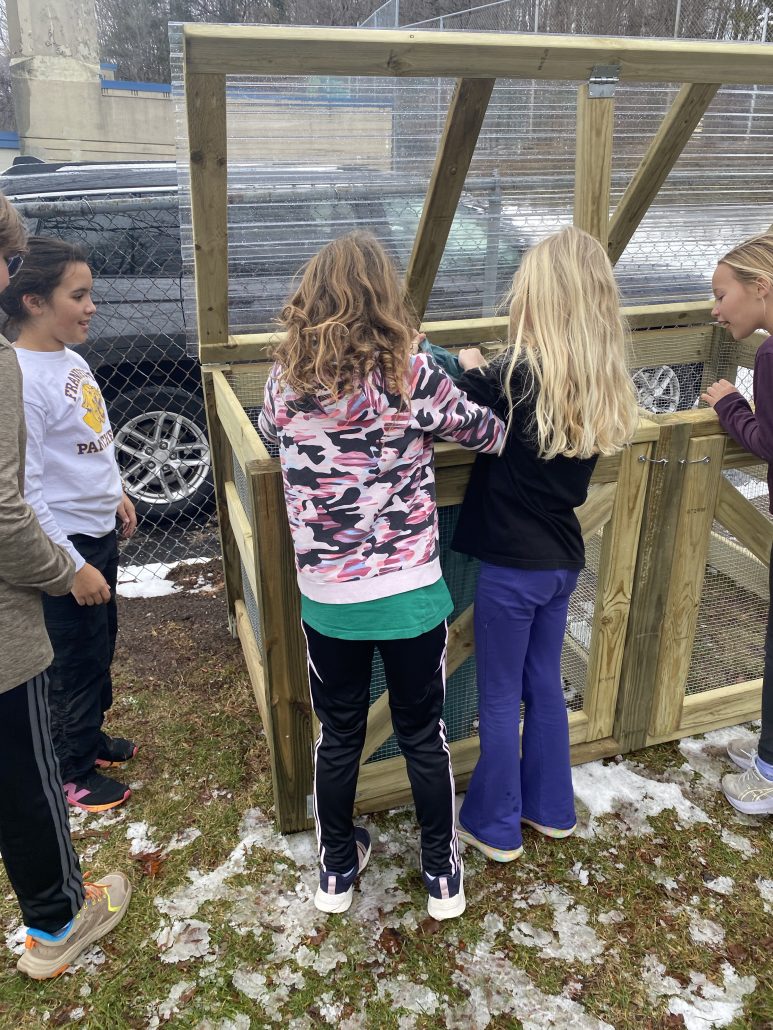
Noah explained that, after lunch, the group takes the compost buckets outside to the bin that they built.
In addition to taking the school’s food waste, the students felt strongly that they wanted members of the community to be able to bring their food waste from home to the school compost. They originally toyed around with the idea of curbside pick-up but decided logistically it would be better for community members to transport their own food waste instead.
What do the students plan to do with their compost?
Well, use it, of course!
Another project that this group of students chose to tackle was to expand the school’s garden areas—particularly with native flowers, such as aster, black-eyed Susan, blue wild indigo, butterfly milkweed, cardinal flower, and columbine, all chosen by the students as their favorites among those that they researched.
“We had a meeting with Ms. Gwaltney. She said that she already had a plan and money for raised garden beds, so we went outside to see how much space we had for the garden,” Harper told the school board.
Sophia continued:
“After that, we laid out a plan, saying 30 of each flower and how much space we had between each plant.”
The students had to research the best time to plant the seeds and which companies had seeds at prices that would fit within their budget; they also researched seed trays at the length and width that they could use.
Later this spring, the group will be building the raised beds.
“Emma and I have a meeting with Anne Gwaltney later this month to get plans finalized for the layout and timeline,” Tarkington says. “The initial plan for the kids was they wanted to do a native plant garden, and so we’re going to be blending that in with a traditional flower and vegetable garden, because there is so much room back there.”
When asked why the students chose to use native plants, Harper responded that they would be easier to care for, since they are native to this region and also:
“We wanted to help the environment, too.”
This seems to be a trend, when it comes to the Wonder Woman group: composting food scraps, in order to lessen waste and create soil; gardening with native plants that would bring in more pollinators; and their third project of building homes for local wildlife—especially those that will help with pest control in the gardens.
“Our first step for bat boxes was to research different bats in our area,” Rebecca said during the group’s presentation to the school board. “We then chose a design for the northern long-eared bat [Myotis septentrionalis], because they are endangered. Our next step for birdhouses was to research local birds and bird houses. Did you know that cardinals and robins like open bird houses? Chickadees and nuthatches, on the other hand, like closed ones.”
The plan is to put up two bat boxes at the elementary school, and the rest will go home with students, to put up in their own yards.
“We’re doing eight bat boxes for the kids and a few less for the bird boxes,” Tarkington says. “We have just about all of the bat boxes done. We’re going to start on the nuthatch boxes and the robin nesting boxes soon.”
When asked about the reaction from their peers at school, Maggie said:
“A lot of our classmates are very enthusiastic about the composting. And some of them have questions about it. Like, ‘When can we join?’”
With only just over two months of school left, Tarkington confirms that the Wonder Woman group are already seeking their successors:
“They’re looking to recruit 4th graders to come in and take over the maintenance for next year, to make sure [the compost project] doesn’t die on the vine, and they’ve got some kids interested”.
He continues:
“From my perspective, this is an amazing group of kids. It’s an incredible crew. I’m amazed by their thought process and their wish list and their dreams of really making a change and having an impact on the community… Everything that they have done, they have done based on their own initiative.”
One other project that students hope to take on before the year ends: building donation boxes and designing posters to raise funds for the Benzie County Animal Shelter.
All in all, these hands-on, project-based-learning times twice a day have meant that this group of eight students have been able to use their reading, writing, researching, and math skills to create concrete change in their school and home environments—influencing fellow students, teachers, parents, and community members.
“It’s exciting when we give students a voice in what they want to work on,” Gwaltney says. “This group came in with some definite ideas about things they wanted to work on in their community, and we’ve tried to help them and guide them and let them pursue what they’re passionate about.”
When asked how the group got the name “Wonder Woman,” Rebecca claimed that the idea came from one of the 5th grade teachers, Mrs. Myers:
“We asked the group if we wanted to change our name to something different, and everybody said no.”
At this point during the school board meeting, a few of the boys began to grumble.
“Well, they were outvoted,” Maggie said.
“I wasn’t here when they voted, so I did not have a say in that,” Brixton clarified.
“Still—outvoted,” Maggie said smugly.
Apparently, these 10- and 11-year-olds have also learned a powerful lesson in civics.
Members of the community who are interested in bringing their compostable items to the Frankfort Elementary School—located at 613 Leelanau Avenue—can do so after school hours: after 5 p.m. on Mondays through Fridays and all day on Saturdays and Sundays. There is a sign that says what is allowed to be dumped into the compost bin, which is located on the playground on the north side of the basketball court, against the fence.
Volunteers are needed at FEAS elementary, middle, and high schools for both in-school and after-school activities. Anyone who is interested in learning more about how to become a volunteer and/or has ideas about new clubs should contact Carrie Gray, the volunteer coordinator, by calling 231-459-2139 ext. 226 or email cgray@frankfort.k12.mi.us; you can also learn more about volunteering at Frankfort.k12.mi.us/community/volunteers online.
*Title I is the largest federal K-12 education program in the United States, with funds from the U.S. Department of Education benefitting around 25 million children annually, according to the Bipartisan Policy Center—that is close to half of all K-12 students in the country. The program provides supplemental funding to local school districts with high percentages of children from low-income families—in the case of Frankfort, that is roughly 50 percent. Passed as part of the Elementary and Secondary Education Act (ESEA) and signed into law by President Lyndon B. Johnson (D) on April 11, 1965, the program’s goal is to ensure that all children have a fair, equal opportunity to obtain a high-quality education and reach proficiency on state academic standards. Approximately 50,000 to 60,000 public schools, or roughly 60 percent, receive Title I funding. While Title I serves grades K-12, the majority of students served are in the 1st through 6th grades.
Editor’s Note: Title I is not the same as “special education.” Title I (ESEA) is federal funding for high-poverty schools to improve academic achievement for disadvantaged students, while special education (IDEA) provides tailored services for students with documented disabilities—both programs offer support but with different legal requirements and student populations. Title I focuses on low-income demographics to improve academic performance for all, including reading and math interventions, while special education (IDEA) focuses on identified disabilities and requires a legal document, called the Individualized Education Program (IEP). However, a student can receive both Title I and special education services, as they are not mutually exclusive. In short: Title I helps disadvantaged children to meet state standards, while special education ensures specialized instruction for special needs.
Full Disclosure: The student Sophia, named in this story, is the niece of the co-owners and editors of this newspaper, Jordan Bates and Aubrey Ann Parker, who also serves as secretary on the FEAS Board of Education.
Featured Photo Caption: Earlier this winter, students in the 5th grade “Wonder Woman” group carry a compost bin that they built from scratch outside to the playground at Frankfort Elementary School. Every school day since, they bring buckets of compostable materials from the lunchroom to the bin. This spring, they will use the compost in raised garden beds that they will build and plant native flowers in. Image courtesy of Emma J. Kelly/Frankfort-Elberta Area Schools.