Questions & Answers with community faces
Crystal Alton (36) grew up in Beulah and graduated in 2008 from Benzie Central High School, where she ran cross country and earned All-State honors in soccer. She then attended Michigan State University (MSU), where she graduated in 2013 with a Bachelor of Science in Engineering (BSE) degree in chemical engineering.
However, for the Fall 2011 semester, Alton studied abroad in Spain at the Universidad Politecnica de Madrid—this, along with her three years of high school Spanish back in Benzie County, will come into play later in Alton’s story, but we are getting ahead of ourselves.
During her college years, Alton had several internships in the industry, as she tried to find something that inspired her: from clothing production at Peckham Inc. in Lansing to chemical manufacturing at DuPont in Tennessee to car coatings/paint at General Motors in Warren, Michigan, even a stint as an “ice cream engineer” at Unilever in New Jersey. She also worked in an MSU lab doing research on organic molecule-based solar cells. After college graduation, Alton went to work for General Mills in Buffalo, New York, for two years.
Then in 2015, she made the big move all the way across the country to California to work on a solar start-up, cofounded by the same professor she had worked under at MSU. The company was called Ubiquitous Energy, and the project was to create transparent solar cells, which could be used for applications from cell phone screens to skyscrapers. Alston spent nine years working on that project as a process engineer in a lab that was fabricating solar cells, eventually moving up to a director-level position, focused on process scale-up for manufacturing. But the company was unable to fundraise sufficiently, and in April 2024, they closed their doors.
Alton had been feeling exhausted for a while. More than exhausted, she was looking at her life in the Bay Area and wondering, “Is this it?” A recent neck injury added physical pain to the emotional tornado of losing a nearly decade-long job, and no amount of human-made entertainment was filling the wounds she was feeling. An aunt, seeing Alton at this low point, recommended a book that she had recently read, about a wildlife sanctuary in the Bolivian jungle.
Alton connected so much with the author’s story that she decided to “take a break” from working by volunteering for “a few weeks” at the Sanctuary Ambue Ari, run by the nonprofit Comunidad Inti Wara Yassi (CIWY). The sanctuary has everything from monkeys to pumas, from red macaws to coatis—a mammal similar to racoons. Some of the animals are rehabilitated and able to be released, while some spend the rest of their lives in enclosures that are built in the jungle, so they can live in their natural habitat but with ample food supplies and without the fear of predators.
“I had traveled before, but never like that,” Alton says. “Never to the jungle in a Spanish-speaking country that I couldn’t have pointed to on a map before reading this book. I knew I needed to go to prove to myself that I could or be forever disappointed in myself—and I knew that I needed to go now or that I never would find the time.”
Originally, Alton’s plan had been to volunteer for just six weeks, from mid-July to late August during the summer of 2024, and then return to a “real job” during the fall of 2024.
But Alton ended up falling in love, many times over: first with the seven wild cats that she was assigned to care for, then with her assigned roommate, Raúl Torres (32), a Mexican photographer, who had ridden his bicycle from Mexico to Bolivia, on his way to the tip of South America. Taking a few months for a break at roughly the mid-point of his trip, he was on site as an artist-in-residence, with the goal of creating a documentary film about the sanctuary.
Ultimately, Alton pushed back her departure date, which meant both she and Torres were at the sanctuary for wildfire season—in addition to their work with the animals, they now were battling fires. This involved cutting and clearing fire-break trails with machetes and rakes, carrying water to strategically placed water barrels, and occasionally directly putting out fires via yellow five-gallon water backpacks with attached spray nozzles.
One of the animals impacted by the 2024 wildfire season—in which nearly 25 million acres were burned in Bolivia—was a female jaguar cub, between seven and nine months old, who had been found alone, without her mother.
Jaguars typically live with and learn from their mothers until the age of two, but Yaguara, as she became known, was too young to survive by herself in the wild. Since she arrived without prior exposure to humans, she did not associate humans with food, comfort, or social interaction, which was good, but she was still too young to survive independently. However, Yaguara was old enough and healthy enough to not require prolonged medical treatment or human-dependent care, making it possible to raise her with minimal human contact.
Because of these factors, CIWY decided to undertake the process of liberating Yaguara—a process never before carried out in Bolivia.
At this point, Alton and Torres came up with a plan: they returned to California, so that Alton could downsize and move her remaining belongings across the country, back to her mother’s house on Homestead Road, here in Benzie County. In January 2025, the couple returned to Ambue Ari, this time for a six-month assignment as staff members, not just volunteers.
Over the course of his time at the wildlife sanctuary, Torres finished two documentary short films: 30-minute Sanctuary, about CIWY’s work generally, and 35-minute Tribu, about a “tribe” of howler monkeys at CIWY who were preparing for reintroduction into the wild. The films are mostly in Spanish, with some English-speaking interviews; however, Alton created the English subtitles for the films.
This was her first foray into the media industry—and she realized that she found this new challenge very rewarding.
In August, 2025, Alton and Torres decided to leave the wildlife sanctuary to continue on the journey that he had originally started, but with a new purpose—they would use the rest of the bike trip to raise awareness and funds for Yaguara’s release back into the wild. And upon completion of the journey in Puerto Montt, in the Chilean portion of Patagonia, they would take a bus back to Bolivia to create a documentary film about Yaguara’s journey.
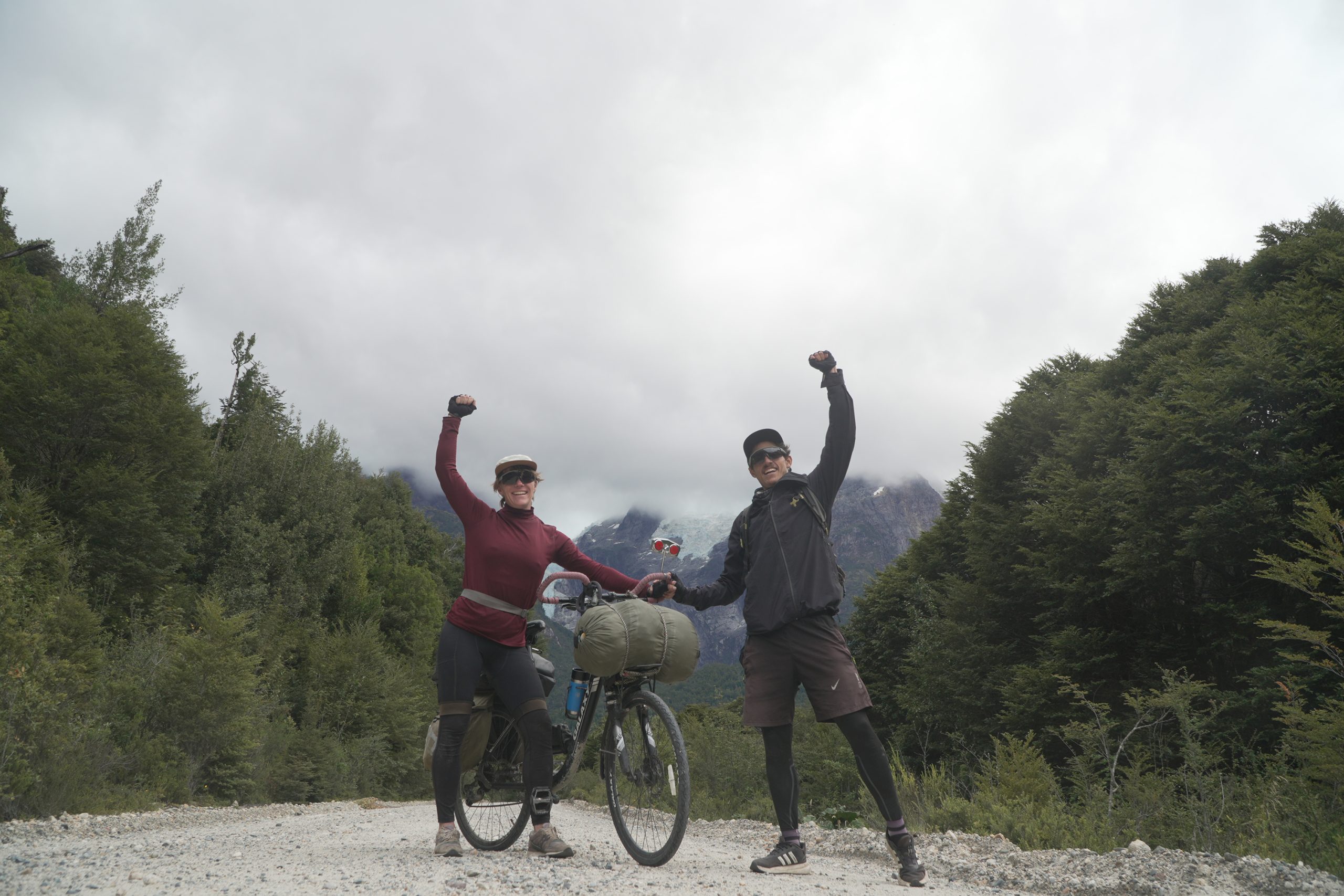
They called the project El Camino del Jaguar, which translates to “The Path of the Jaguar,” and from August 28, 2025, to February 19, 2026, the couple biked 3,200 miles across South America.
Continuing with our interview series on impactful Benzie County characters, The Betsie Current caught up with Alton back in January 2025 as she was unwinding at a camp site during a rest day from the bike trip. (This interview represents how she was feeling during this trip, though now she and Torres are back at the wildlife sanctuary in Bolivia, awaiting the release of Yaguara later this spring.)
The Betsie Current: What made you decide to leave most of your worldly possessions behind to volunteer in the Bolivian jungle? How did that lead to biking through multiple countries, to the tip of South America? How did you get involved with this cause, and why are you passionate about it?
Crystal Alton: I spent eight years working at a Bay Area solar start-up. In April 2024, the company closed its doors. Around that same time, I had read a book that changed my life—The Puma Years is a memoir by Laura Coleman about her experience at CIWY’s Sanctuary Ambue Ari in the Bolivian Amazon. In it, she recounts meeting and falling in love with a puma named Wayra and living through the Bolivian wildfire season. I was deeply touched by the love I felt in that book, and so, when the company where I had been working shut down, I decided to go to the Bolivian Amazon, as well, to experience the place for myself. While there, I met my now-partner, Raúl, who was in the middle of a long-distance cycling journey through South America. We ended up spending the better part of a year at the sanctuary, falling in love with the project, the animals, and the jungle. During that time, a young jaguar, named Yaguara, was rescued during the wildfire season and was brought to the sanctuary. The organization decided that her best chance would be a return to the wild, rather than permanent captivity, like all of the other jungle cats at Ambue Ari. This process has never been attempted before in Bolivia. When Raúl and I finally decided to leave CIWY, we created a project to support this jaguar’s liberation. It was a cycling fundraiser called El Camino del Jaguar. We created a GoFundMe fundraiser online, educated ourselves on jaguar-liberation protocols, and began sharing Yaguara’s story, both online and in person. So far, this effort has raised more than $7,000 toward her liberation, and we have shared her story with thousands of people. But I want to be clear about something: Yaguara’s liberation is CIWY’s work. The organization has been building to this for decades; they have the expertise, they built the infrastructure, they negotiated the politics. We joined the effort, raised some money, and tried to get more people to pay attention. We helped in the way that we, with our particular experiences, knew how. CIWY has an enormous international community of supporters—people who have volunteered there, donated, followed the work for years—and that network is a big part of why this project was able to move forward. I’m passionate about this work, because I’ve come to realize how separate my “normal life” was from the natural world and how that distance made it possible to not see the real devastation that is caused by rainforest destruction. Living in the jungle for almost a year, getting to know the animals at the sanctuary, and literally fighting fires to protect their habitat changed that for me. Through that experience, I came to believe, deeply, that conservation is the most important work humans can do and that far more of us need to be directly engaged in it. Our next project will be to try to share that message with the world, through a documentary film about Yaguara.

Current: Tell us a little about what it was like working for almost a year at a wildlife sanctuary? Where did these animals come from? What did a typical day look like for you back then?
Alton: Nearly all of the animals arrive at the sanctuary with a story that will break your heart—and nearly all of those stories have humans behind them. In many cases, wild cubs are kept as pets after their mothers are killed for their teeth, fur, or claws. Eventually, these cubs are either reported and confiscated or voluntarily turned over, when owners realize that keeping a puma, ocelot, or jaguar is not a good idea. These are wild animals with wild instincts; they don’t belong in a yard or a living room. Others arrive through different types of rescues. One of the pumas I worked with, Valo, was found after land was cleared for agriculture. He was lying next to another cub, likely his brother, who didn’t survive, and their mother was never found. Every animal has a unique story, and as a volunteer, I was assigned specific animals and learned their specific background. I also learned how to care for them. Volunteers see the animals every day, so we do most of the hands-on work and report any behavioral changes or health concerns to the veterinary team and staff, who can’t be with every animal daily. Along with providing food—raw meat—and water, we clean and maintain enclosures and create enrichment. Enrichment is necessary, because these animals will spend the rest of their lives in captivity, and their worlds are now very small. It’s anything that provides stimulation: a toy, a structure to climb, or a new scent. All materials come from the jungle. I learned to make balls out of vines, build structures with bamboo and palm leaves, and find logs at just the right stage of decay to interest the animals. These enrichments are added daily to reduce stress and boredom. Twice a day, I would grab my meat bucket, water bottles, machete, and keys, and head into the jungle for a three-hour session. The animals live far apart from one another, in private jungle enclosures, so the walk could take up to 40 minutes, past monkeys, coatis, birds, bugs, mud, and swamps, before arriving and greeting them with a “Hola!” And then, I would spend time with them. These animals were taken from the wild very young and have become used to people. Many rely on humans as their only form of social interaction. It sounds strange, but after a few weeks, you start to think of them as friends. You care for them, create enrichment, feed them, and talk to them. It’s a beautiful connection; but the longer you spend with them, the heavier it becomes, knowing that they will live the rest of their lives in those enclosures.
Current: What does a typical day look like for you right now?
Alton: My day typically starts around 8 a.m. with a 10-minute meditation, and then I make coffee. This detail is important, because during the first month of this travel, we did not have a way to make coffee, and I learned just how important it is to me! We like to drink our coffee and watch the birds—there are so many beautiful species that we have learned to recognize—while we discuss our plan for the day. Each day, we talk about the work we need to do, how far we want to ride, and where we expect to sleep. After packing up our campsite, we head out onto the road. We typically bike several hours per day with rests, during which we work on El Camino del Jaguar social media and other projects. We discuss, research, write, film, edit, and design. We talk about Yaguara and Bolivia a lot. And when we find a breathtaking landscape, new bird, or wild animal, we stop, observe, and film. While biking, I listen to a mixture of music, podcasts, and audiobooks. Lately, I’ve been drawn to ideas like “donut economics,” which looks at how we can meet basic human needs while still respecting the planet’s limits. It’s a framework that resonates deeply with this way of traveling and with the work that we’re trying to support. During the early evenings, we start looking for a place to camp. Often, we camp in the wild. Other times, we ask permission from the owners of roadside restaurants. Typically, they say yes; they are interested in our story. And when we leave the next day, the El Camino del Jaguar flyer is often on display, helping to get the word out about our project along the route that we’ve biked.
Current: So much of your daily life now is in Spanish. Where did you learn the language? Did you find it difficult to learn? Have you faced any language and/or cultural barriers, and if so, how have you dealt with these?
Alton: My first exposure to Spanish was actually at Benzie Central High School, where I had three years of the language with Señora [Cheryl] Smith. Several years later, during college, I studied abroad in Madrid, Spain, continuing at an A2 [advanced beginner] level for a semester. More than a decade passed between my time in Spain and my first visit to Bolivia. When I first arrived at Ambue Ari, I understood almost nothing and could barely communicate even the most basic ideas. But the grammar concepts and general feel of the language were still somewhere in my brain—just quite dusty. When Raúl and I met, his English was very basic, and my Spanish was even more so. Conversations that would normally take five minutes often took us multiple hours, but we stuck with it. In those first months, we created a flexible structure: one day we spoke only Spanish, the next only English. We’ve continued using that system, and it’s helped both of us to become much more fluent and confident in our respective second languages. I also use free tools. Mihalis Eleftheriou’s Language Transfer app teaches you how English and Spanish both have Latin roots and how this can be used to help you find words and understand the grammar. And by using Duolingo, I make sure that, every single day, my mind is exposed to the language. They are both helpful, but nothing compares to immersion. I’ve now spent over a year traveling through Spanish-speaking countries, and the constant exposure to native speakers and different accents has been irreplaceable. But, while the experience has been incredibly beneficial for my Spanish-speaking journey, it has also been very challenging at times. It’s surprisingly easy to lose the thread of a conversation by missing just a few words—and I lost many threads. I often had to ask people to slow down, repeat themselves, or simply accept that I wasn’t going to understand the story we were being told. Once in a while, that’s a fun experience. Living it daily was hard. To ease the day-to-day difficulties, I sometimes relied on Raúl to communicate for us. It made things logistically simpler but could also be challenging in a different way. There were moments when I didn’t feel like the strong, independent woman I’m used to being. Now, though, I feel like I’ve moved past the hardest part. I’m often surprised by how much I understand in daily conversations and at how well I can respond. My grammar isn’t perfect, but it’s more than enough to be understood—and I even get the occasional compliment from a surprised stranger: my Spanish is pretty good for a gringa!
Current: What are the biggest challenges of what you are doing? What is the best or most rewarding part of this project?
Alton: The challenges have shifted along the way. Initially, I would feel a lot of anxiety around the travel logistics, especially where we would sleep, but as the trip has gone on, I have come to trust that the road will bring us what we need. Now, the biggest challenges are related to the project itself. We are still working on determining what content is going to resonate with viewers. That is particularly challenging, when world news is heavy with violence, wildfires, deforestation, and rising emissions. In the last month alone, Argentinian Patagonia and Chile have faced devastating fires. It can feel overwhelming. But as a friend we met along the way said simply, “Hay que intentar.” We have to try. The most rewarding part of this project is seeing the tangible impact. Every month, we send the funds that we have raised to Ambue Ari, and every month, we hear how much it helps. Knowing that our efforts—and the efforts of our supporters—are directly helping to repair some human-caused damage is profoundly motivating and affirming. We also receive occasional news from CIWY about Yaguara: how much she has grown, that she moved into her new enclosure, that the government has officially approved her release project. Each update is a heartening reminder of the importance and reality of this project.
Current: How have you seen your work grow and change? How do you hope that it will continue to grow? What is next?
Alton: My work has grown and changed significantly over the course of El Camino del Jaguar. In my previous life, I was an engineer focused on process optimization and research and development. Now, I spend my time on fundraising and social media. I started from zero; I didn’t know how to do any of this. I learned how to create a GoFundMe, to build a content calendar, to research and tell stories, to edit videos, and to speak directly into a camera in a way that effectively communicates a message I care deeply about. Becoming comfortable with that visibility was a process, but it is crucial for this type of conservation work. I’ve also been introduced to the world of film and film festivals. Raúl’s documentaries have now been submitted to around 20 international festivals, with several acceptances and awards already. Knowing that these films are reaching new audiences and sparking conservation conversations has been incredibly gratifying; I helped with the Spanish-to-English translations for the films’ captions. One of the most exciting developments has been the collaborations that this project has sparked. Most recently, friends of Raúl’s in his hometown of Querétaro, Mexico, organized a documentary screening and photographic exhibition featuring CIWY’s animals, titled “May the Wild Remain Wild.” The event helped to spread awareness and opened the door to additional exhibitions and future screenings. We hope this growth continues across all of these branches: for our social media to keep gaining traction and generating support; for Sanctuary and Tribu to continue circulating through film festivals; and for more artistic collaborations and public screenings to amplify CIWY’s work and inspire increased involvement in conservation. Beyond that, the next major milestone will be Yaguara’s liberation itself, though the date has not yet been finalized. When it is, Raúl and I will return to Ambue Ari to document the process—we will interview the core team, film the daily work of the sanctuary, and ultimately capture Yaguara’s release. Then, we will create a documentary to share her story. The intention will be to educate and inspire people to engage in repair work and to emphasize that it is never too late to start.

Current: What do you think that you are doing differently than others in this field?
Alton: To be honest, I don’t know anyone else doing something quite like what we are doing. I see photographers, filmmakers, and influencers posting incredible wildlife imagery or sharing the stories of NGOs doing powerful conservation work, but what I think is different about our approach is that we are living the experience as we are sharing—instead of documenting from the outside, and rather than creating a purely informational documentary, we are living inside of this project, as it happens. This combination of bikepacking, fundraising, sharing, and creating a feature-length documentary focused on Bolivia’s first jaguar liberation is unique and deeply personal. By sharing both the conservation work itself and our stories of personal transformation toward and through that kind of work, we hope to make conservation feel more accessible and to inspire others to take action.
Current: Some people might ask, “Why put so much effort into just one animal?” What do you have to say to them?
Alton: It’s a good question, and I have few answers to it. First, this work is not actually just about one animal. Yaguara is the first jaguar to undergo this rehabilitation and release process, but once the process has been done this first time and the physical infrastructure is in place, this will be a repeatable process. Sadly, large felines continue to enter into captivity, and being able to return to the wild when possible is a far better and more natural second chance at life than living within the bounds of an enclosure. It also improves life for the other animals that remain in captivity; the limited available resources can be used in caring for the felines that truly need to be there—those dependent on humans, because they were taken from their mothers young, or those with injuries that would make survival in the wild unlikely. From a financial perspective, the cost of keeping a feline in captivity for life [20-plus years] is immense. Once a release protocol exists, returning animals to the wild can actually be more cost effective than caring for them for life. On a more emotional level, I have seen what captivity can do to these animals. Often, they display stressed behaviors, from pacing to over-grooming to sucking their tail. It’s hard to see; you feel helpless witnessing their pain. These animals were never meant to live in human care, and even the best sanctuary can’t replicate the sensorial stimulation or social dynamics of the wild. Through this work, I have also come to see that each of these animals is a unique individual, with its own personality. They each have a right to exist, just as much as we do. As a species, we have taken so much from them, and we continue to do so. The very least we can do is try to give something back.
Current: How have you seen Benzie County change since you grew up here? What are your hopes for the area in the future? What could Benzie County do to attract more and/or retain talented people in this area? What else does Benzie County need?
Alton: I’ve spent most of my adult life away from Benzie County, so my perspective comes from returning home for vacations and comparing it with what I’ve seen elsewhere. On each visit, there are several things that I always do, and I hope these treasures are preserved. I visit the beaches, particularly Frankfort and Esch Road/Otter Creek. I spend time in the woods. And I support local businesses that have popped up since I left, such as Stormcloud Brewing Company in Frankfort. What feels special about Benzie County is the combination of extraordinary natural beauty and a strong sense of community. More than a decade after leaving the area, I still run into people I know when I’m back home, out and about. That kind of community matters. As I think more broadly about what a place needs to attract and retain talented people, I reflect on what first drew me to the Bay Area—and, conversely, why I don’t intend to return. It is a creative, exploratory community that values self-expression and freedom. There is space for people of every background, identity, and interest. And when I moved there, there were abundant job opportunities across fields, ranging from technology to education to nonprofit work. But it is also an expensive place to live, often prohibitively so, and deeply unequal. It is densely populated; driving five miles can take up to 30 minutes, and the public transportation system and highway infrastructure do little to relieve that burden. Benzie County is, of course, a very different place. But my lived experience suggests that three things matter everywhere. First, opportunity matters: there need to be jobs in fields that attract and retain talented people. Second, belonging matters: people gravitate toward places where they believe they will find community. Third, cost and quality of life matter: people need housing they can afford and infrastructure that is reliable and useful. Finally, many talented and motivated individuals are acutely aware that we are already living in a climate crisis. One opportunity for Benzie County, and Michigan more broadly, may be to position the region as a relative climate refuge—a place with fresh water, resilient ecosystems, and winters that still exist. Protecting those assets while building inclusive, opportunity-rich communities could help the region to grow sustainably. My personal hope is to return and build a life there, once this journey is over. I’m drawn to the possibility of living in a place that values its natural environment, maintains a tight-knit community, and offers the chance to make a meaningful, positive difference.

Current: Yours is such an inspiring story—you are helping to release the first jaguar back into the wild in Bolivia, something that has never been done before! What advice do you have for people who are looking for motivation, for passion, for creativity, for meaning?
Alton: When I try to formulate this adventure into some sort of coherent advice, I always go back to the beginning, to the feeling that something wasn’t right and that I needed a change. I would say listen to your intuition, trust yourself, and when you feel something awaken in you, follow it—even if it sounds hard, even if you have never done it before, even if your friends and family don’t understand. Follow it until you know why you were awakened.
El Camino del Jaguar supports the work of Comunidad Inti Wara Yassi (CIWY) and the Ambue Ari Wildlife Sanctuary in Bolivia’s Amazon jungle. Learn more about El Camino del Jaguar and support the project by visiting
GoFundMe.com/f/el-camino-del-jaguar online. To follow the journey and stay up to date on the project and upcoming documentary work, follow Crystal Alton on @cstall_dawn on Instagram. Send an email to spartan.crystal@gmail.com for additional information or inquiries.
Editor’s Note: Our editor and co-owner Aubrey Ann Parker was vacationing with family in January 2026 in Querétaro, Mexico, randomly at the same time that Raúl Torres’s friends were showing his first two documentary films in a cafe and raising funds for El Camino del Jaguar, so she attended—talk about a small-world connection to be in the same city at the same time, of all the places and times to be there!
Featured Photo Caption: Crystal Alton (36, left) and Raúl Torres (32, right) after completing a 3,200-mile bicycle trip from Bolivia to Chile, in the southernmost tip of South America. Image courtesy of El Camino del Jaguar.