15 years in print
By Aubrey Ann Parker
Current Contributor
I am really bad at marking milestones, both personally and professionally. Slowing down enough to really savor something is so difficult for me, figuratively and literally—yes, I am a fast eater, and I have been known to win a local eating contest or two. (Shout out to The Cabbage Shed; if you know, you know.)
But this one felt too big to miss out on.
The Betsie Current is turning 15 in 2026, and in this age when the “news” industry is evolving at breakneck speed, that feels momentous.
Nearly 70 percent of local news outlets in the United States are still newspapers, alongside television, radio, and digital-only news sources. However, in just the past two decades, close to 40 percent of all local newspapers in the United States have shuttered: there were close to 8,900 newspapers in 2005, but that number is down to 5,400, according to the annual “State of Local News Project” by Northwestern University’s Medill School of Journalism. (In contrast, there had been 24,000 U.S. newspapers during the early 20th century.)
The rate over the past two years has been the equivalent of around 2.5 newspapers closing every week—148 either closed or merged in 2025 alone. Only 10 percent of those had been controlled by one of the largest companies; rather, most of last year’s losses were smaller, independent chains and news outlets, much like ours.
Currently, 212 counties throughout the country have no newspaper at all; that number was 150 in 2005. Moreover, 1,525 counties—or close to half of all counties in the United States—have only one news source, which means more than 50 million Americans have limited or no access to a reliable source of local news, living in what are called “news deserts.”
Notably, more than 300 “start-ups” have been identified by Medill over the past five years; however, if they are digital-only, that means their news is accessible only to those with reliable and fast internet connections.
Here in Michigan, the stats are much the same as the national picture; we have seen a 40 percent decrease in our newspapers over the past two decades, according to Detroit PBS.
Many newspapers have been sold to major chains—MLive, Gannett, Media News Group, Hearst, and Boone, among the big ones—which has significantly changed the media landscape in our Mitten State, with many (formerly independent) papers now under the control of these large national chains, often resulting in reduced local coverage in some areas. Two counties in Michigan have no newspaper at all, while more than 35 counties are served by only one newspaper, often limiting the presence of independent alternatives.
“Local news is democracy’s watchdog at the grassroots level,” according to a video by Why It Matters. “When newspapers disappear, transparency plummets; municipal borrowing costs increase, because there’s less oversight of tax spending; voter turnout drops in local elections by as much as 20 percent; corruption increases, because no one is watching City Hall.”
The video continues:
“But this goes beyond politics. Local news creates community connection; it covers new business openings, school achievements, and neighbors helping neighbors. Without these stories, communities become collections of strangers, rather than connected neighborhoods. The void gets filled with what researchers call ‘pink slime journalism’—low-quality, often partisan content… Economic development suffers, because businesses need local media to reach customers… When people can’t find trustworthy local information, they either disengage completely or turn to unreliable sources that spread misinformation. When local news thrives, democracy thrives.”
We could not agree more.
So for this first issue of our 15th season, we thought that we should dedicate the entire issue to letting our readers in on a little “behind the scenes” of what it is like to own and operate a newspaper in a small, very rural community.
For those of you who are frequent readers, it probably comes as no surprise that I co-own this small newspaper with Jordan Bates, my partner in love, life, business-, house- and dog-ownership.
We publish 16 issues in a year: typically once a month from January through May, then every other week from Memorial Day through Labor Day (eight summer issues at that fast clip), then back to once a month from September through December. (Note: Up until 2020, we only published 12 issues a year; basically we took January through April off.)
The reason for less issues in the fall, winter, and spring when compared to summer is pretty simple: ad revenue.
Since our paper is free to the public, it is paid for by ad sales.
If you follow me and my antics at all—politics, volunteering, coaching, serving on boards, creating/promoting events, rescuing street dogs—this should come as no surprise: in my heart of hearts, I’m a community organizer. And what is more “community” than a free local paper?!
We want our stories and calendar of events to be accessible to everyone: that is also why we deliver to so many places.
It would take me a fraction of the time to deliver (which is about 10 hours) if I only put papers out at the big hubs—400 copies at the grocery stores and gas stations, only doing the “big” towns and not the small ones, etc. Places with a lot of foot traffic. But I really and truly try to deliver to just about any business that is open to the public, even if that means I’m only delivering five copies for the people who work in that office, because nobody else really goes in there. This means that I am delivering to anywhere from 150 to 250 businesses, depending on the season; some places are not open during the winter, for instance.
I get the same question all the time: how do you make any money off of a free newspaper?
Well, the truth is that we don’t make a ton—I like to say that we’re not quite “nonprofit journalism,” but we’re more like “very-little-profit.”
But it’s fairly consistent, and I’m grateful for that.
You can support us by picking up a hard copy, telling an advertiser “thank you,” and following us on social media.
Read more about how our newspaper operates in my 2025 essay: “The Betsie Current, Still Flowing – Tap into your inner George Bailey.”
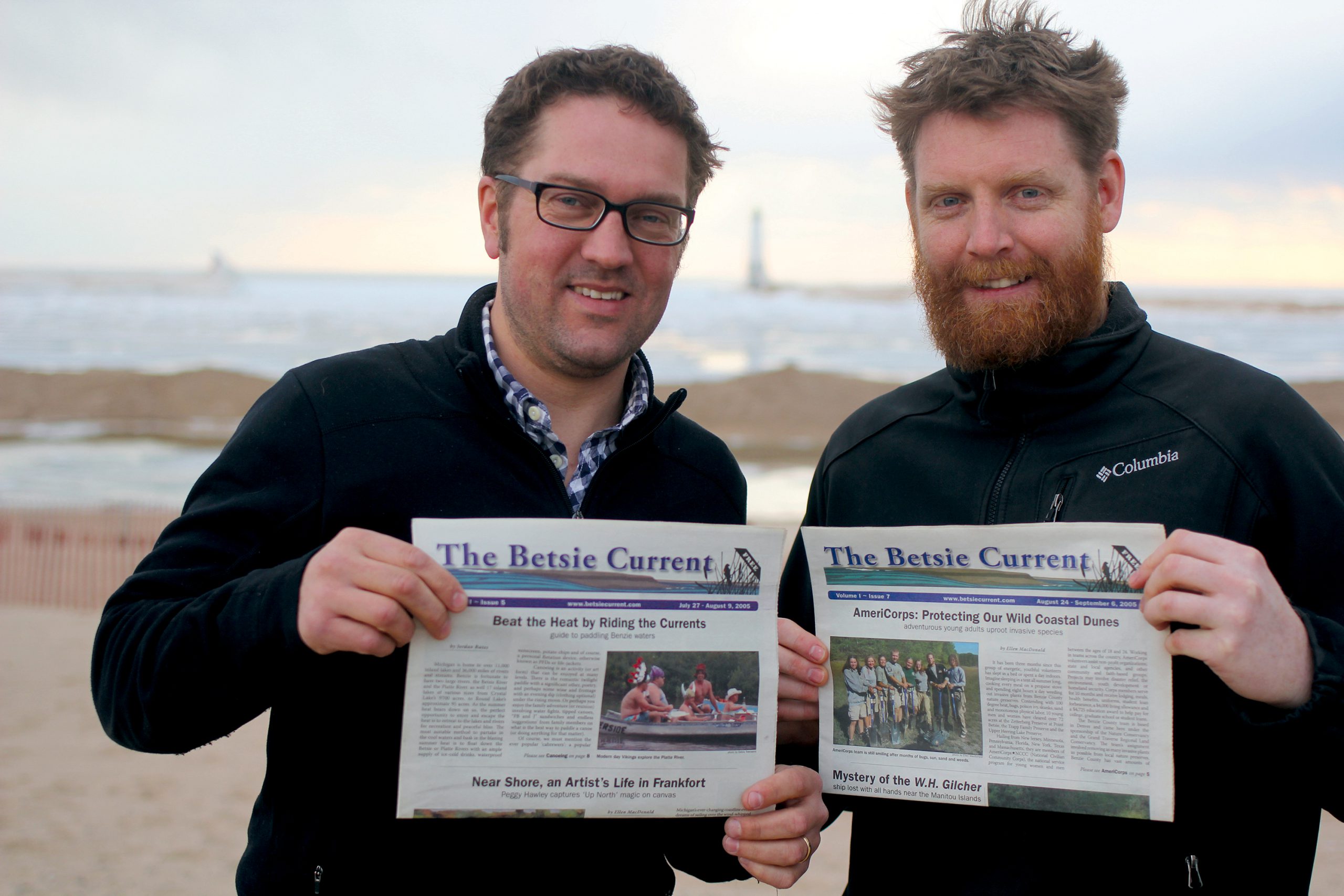
Featured Photo Caption: Jacob Wheeler (left) and Jordan Bates back In April 2014, when we first re-launched The Betsie Current newspaper. Photo by Aubrey Ann Parker.