Migrant farm work has boomed in Michigan recently, but feds just cut pay
By Claire Keenan-Kurgan
Current Contributor
Every year for the past decade, Jose Abel (29) has traveled more than 2,000 miles from the region of Durango in Mexico to tend to the grapes of Northern Michigan’s famed vineyards.
The money he earns during the nine months that he spends in Michigan allows him—and thousands of other Mexican workers in our state—to have dreams back home.
“Building a house in Mexico, buying something to live over there, so you don’t have to keep coming here… starting a business, or having a farm,” he explains.
Now, however, the U.S. federal government has lowered the minimum wage—by as much as $4.50 an hour, or 25 percent, in Michigan—for the exploding number of workers who are here on H-2A visas, like Abel.
The decision comes after a couple of years of outcry from some farmers that the cost of labor, transportation, and housing for H-2A workers had become untenable, and that, without locals willing to do the job, small farms would not be able to afford the cost of the harvest season.
“This move is a key step towards modernizing the H-2A program,” Michigan Farm Bureau president Ben LaCross said in an online press release back in October 2025. “More work needs to be done, but this is a great start.”
Others, however, wonder if the new wages will still be able to attract enough farmhands to do the work that locals do not seem to want.
“We get the same guys coming back every year, and it’s a pretty severe decrease,” says Brandon Evans, a farm manager at the Evans Brothers Fruit Co. in Benzie County. “They’re used to the wages they’ve been getting paid.”
And for the migrants, themselves, “it won’t be the same as before, with the same visions for the future,” Abel says.
Increasing Workers, Increasing Costs
Evans—who grows apples, cherries, and blueberries with his family—says that he and most other apple growers he knows rely on a team of H-2A workers each year.
They post job opportunities locally as the harvest comes around, but “we just never hear anything,” Evans says. “We post the job online for the same rate as the H-2A guys, and nobody shows up.”
Of 415,000 total advertised U.S. farming positions during 2025, only 182 received a domestic applicant, according to The New York Times.

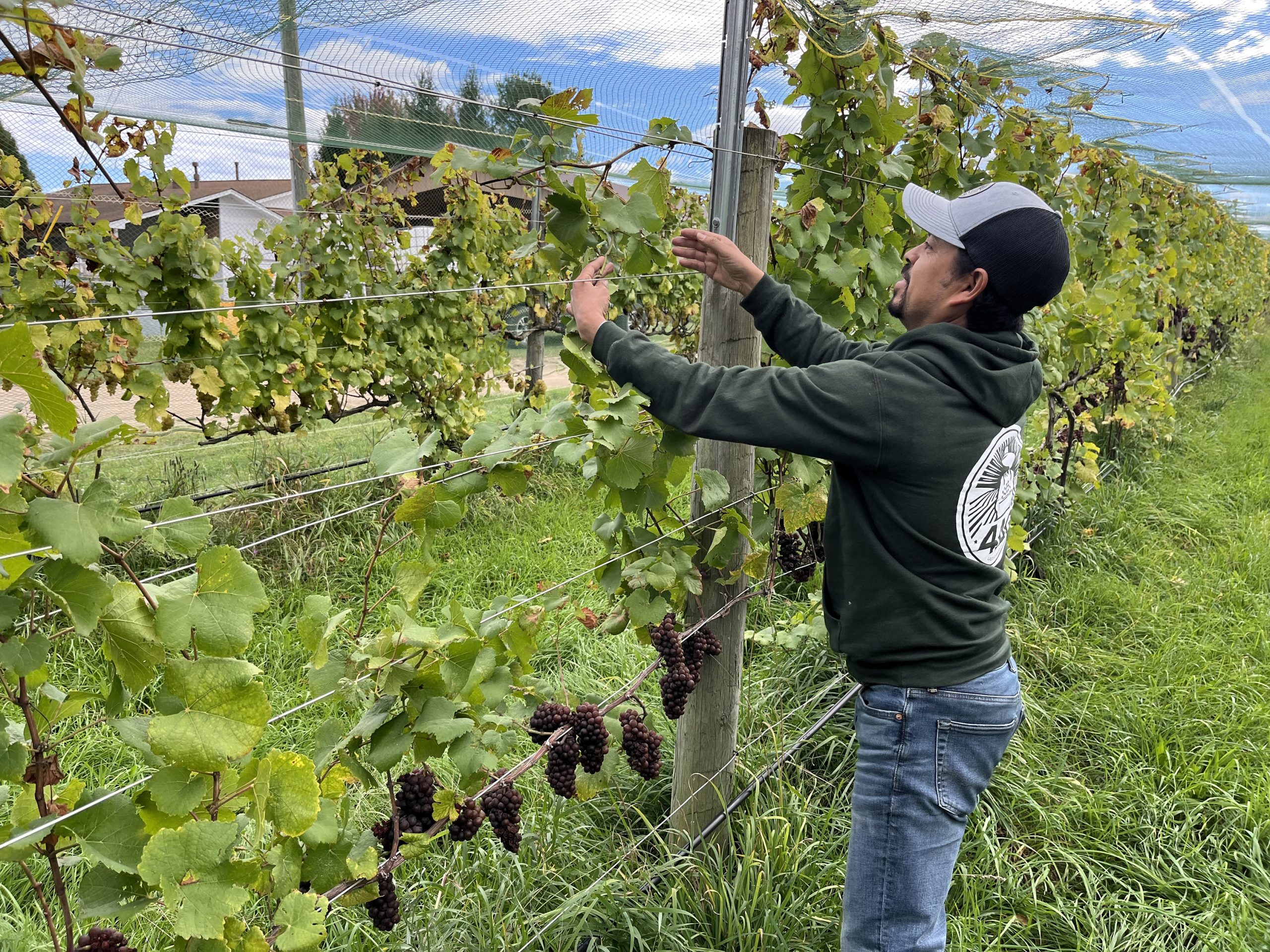
Without domestic help, “the H-2A program has pretty much taken over,” says Tomas Moreno, the vineyard manager at Bel Lago Winery in Cedar, overlooking Lake Leelanau. He also manages a team of H-2A workers who rotate through various vineyards all across the county.
Moreno says he brought 24 workers to Michigan last year and plans to bring 30 this year. He says that vineyard owners from all over Northern Michigan have been calling him, ready to pay premiums for him to set up contracts with migrant workers through the H-2A visa process.
Michigan is a “top 10” state for H-2A work. In 2022, 2023, and 2024, around 15,000 people on H-2A work visas tended Michigan farms, according to U.S. Citizenship and Immigration Services data. That is up sharply from just over 2,000 people less than 10 years ago, in 2015.
Moreover, that number shot up to 15,984 in 2025—almost 1,000 extra workers in a single year.
As use of the program has grown, the minimum wage for H-2A workers rose, too—at least, until now.
In 2022, the federal government set minimum wages for H-2A workers in Michigan at $15.37 per hour. In 2023, that went up to $17.34, and it climbed to $18.50 in 2024, before going back down to $18.15 in 2025, and now lowering even further for 2026.
This wage rate applies to all workers—domestic and foreign—at any farms that use the H-2A program.
But for foreign workers, farmers wind up paying much more than the hourly wage per employee, as farmers are responsible for covering the cost of their housing and transportation, as well as the costs associated with getting a visa.
Those other costs are all climbing, too, Moreno says.
“It used to be that the chemicals that you spray on the trees was a farm’s biggest expense, and now… the labor is, by far, the biggest expense,” Evans says. “People were starting to get worried… that the smaller farms weren’t going to be able to continue to handle the cost of the labor, and they’re going to get bought up by big farms, and the small family farms were going to just disappear.”
Lowering Wages
In May 2025, Michigan Representative John Moolenaar (R-2nd District) told the U.S. Secretary of Labor at a federal hearing that farmers were “under tremendous financial stress” and “just can’t make it anymore.”
So when the U.S. Department of Labor announced in October a new method for calculating the pay rate for H-2A farm work, many farmers breathed a sigh of relief.
For the first time, farmers will be held to two minimum wage rates—one for entry-level workers and another for workers with more experience. The rate will drop in Michigan from $18.15 per hour down to $17.47 for “skill level two” workers and down further to $13.47 for “skill level one” workers.
Zachariah Rutledge—assistant professor of agricultural, food, and resource economics at Michigan State University (MSU)—says that the H-2A wage, officially referred to as the “adverse effect wage rate” or AEWR, was initially designed to protect domestic American workers.
“What [the wage rate] is supposed to do is create a wage for H-2A workers that’s high enough that it doesn’t depress the wages of domestic workers” or incentivize farmers to bring in workers from abroad, he says.
But most farmers say that the cost of subsidizing housing and transportation for foreign workers accomplishes that already.
Rutledge says it remains to be seen how farmers will respond to the changes for 2026.
“Are they going to be able to get the same workers to come back to their farms that have been coming back for years [if they offer a lower wage]?” he wonders.
Scared, Concerned
Meanwhile, migrant workers wonder what is in store for them this growing season.
Moreno, the vineyard manager at Bel Lago Winery, says that many of the workers on his team found out about the possible wage drop through word of mouth or on social media last fall, before he had a chance to figure out how farmers in our area plan to respond.
“They were getting scared, concerned,” he says. “They’re already doing the math of how much they’re gonna be earning and, you know, how much they’ll be sending back home.”
Many of the workers on Moreno’s team would qualify for the higher wage rate, he says, because many of them have returned to Michigan for several years in a row.
He says that he told them:
“I’ll talk to farmers. And I’ll keep the highest pay rate that I can for you guys as possible.”
Abel, the Mexican worker from Durango, will likely qualify for the higher category of H-2A wages in Michigan, and he does plan to return this coming season.
“Unfortunately, there’s barely any work in Mexico,” he says, at least in the smaller town where his family lives, and it is getting more and more common for people from his town to work in the United States on an H-2A visa.
When asked about workers who would make that lower entry-level wage, he says:
“I’d guess that coming here—however low the wages turn out to be—it would still help, compared to staying in Mexico, where it’s hard to get a job.”
Still, he says, he thinks that the wages should have stayed the same, instead of decreasing for 2026.
“Farm work is hard, and not everyone is willing to do it,” he says. “Even if it’s raining, or snowing, we get it done anyway, and I think the salary we get is fair for what we do.”
Claire Keenan-Kurgan is a reporter for Interlochen Public Radio (IPR). This reporting is made possible by the Northern Michigan Journalism Project—led by Bridge Michigan and IPR—and is funded by Press Forward Northern Michigan.
Featured Photo Caption: Tomas Moreno, vineyard manager at Bel Lago Winery in Leelanau County, tends a row of pinot grigio grapes, which were later picked by a team of workers from Mexico that Moreno hired through months-long temporary agricultural work visas, called H-2A visas. Photo by Claire Keenan-Kurgan/IPR.