

A reflection on history—who tells it and how
By Lucy Waechter Webb
Current Contributor
Where does the story begin?
I am tempted to start with the trip I took with my mother to her hometown this past spring. Or when I first got into ancestry work about seven years ago.
But to begin there would be to begin the story with me—and that is not what this story is about.
This story is about the courage of Benny Gordon Jr.
It is a story about the power of everyday people choosing to show up and speak up for their own dignity and the dignity of their neighbors. It is a story about a small group of citizens who refused to accept the status quo in their hometown.
Benny Gordon Jr. was a father, a businessman, a veteran, and a civic leader in Webster Groves, Missouri, a town just outside of St. Louis. He grew up during Jim Crow segregation and was committed to building a community that was no longer governed by the inhumanity of a law that saw us as separate from one another.
In July 1949, as the thick Missouri summer air hung heavy, a 26-year-old Gordon and seven friends decided that it was time to go for a swim in the freshly minted city pool—but they were refused entry, because they were Black.
This spring, I visited that pool with my mom in Webster Groves, her childhood home, for the first time. She remembered riding her bike up the hill to practice for the swim team during the 1960s.
It was here, just a decade earlier, that her grandfather, my great-grandfather, Clarence “Happy” Appel—as the mayor of Webster Groves—denied Black residents access to swim in this city pool.
It was a story that I had not heard growing up but learned more recently in my adulthood, as I began asking questions about my ancestry and our people’s relationship to the history of racial violence in this country.
As we stood there together on the outside of the eight-foot security fence that surrounds the modernized splash pad and water park features of the 21st-century pool, we reckoned with the role of our ancestor in the violence that took place at this site during the 20th century. We spoke words of prayer, apology, and hope.
When we turned to leave, I bent down and took a large stone from the land, a symbol that I was committed to carry the weight of this story forward. I did not know how just then, but I knew that the story needed to live in the telling of my family’s history—and in the histories that I passed on to my children.
Back in Northern Michigan, a few short weeks later, we met Ben Gordon III—son of Benny Gordon Jr.—over the phone. The city’s newly renovated recreation center and pool had been renamed in honor of his father. The dedication was happening in two weeks; he had heard that my mom and I had been in town recently, and he invited us back to Webster to speak at the dedication.
In May, we returned to the pool. I stood there with my mom, my sister, and three of our children, and we offered a public apology for what our ancestor had done.
“Although I was not personally involved in these past actions, we recognize that silence, inaction, and lack of awareness can contribute to ongoing inequity. For that, I am sorry,” my mom said.
Together, we celebrated the life of Benny Gordon Jr. and the change he fought for, and we broke bread with his family.
Just a couple of generations later, we were able to imagine a different way of being together.
During our conversation, Ben Gordon III quoted Dr. Martin Luther King Jr.:
“Love is the only force capable of transforming an enemy into a friend.”
And then he said:
“Over these last years, we’ve been able to have enough love to make this conversation between our families possible.”
His words left me feeling profoundly hopeful.
This public dedication was to honor and celebrate Benny Gordon Jr. specifically.
But for every courageous African American who has pushed back against racial violence, there was an adversary—sometimes many adversaries—on the other side. Often those faces fade into history, as if only real in another time.
When we remember the people in these stories were some of our own ancestors—our grandparents and great-grandparents—we can feel for how we are like them. We can touch the weight of our own choices and complexity more.
Because here is the thing: we are capable of both enacting the same violence of the oppressors or of mustering the same courage of those who resisted.
Now is the time to get clear about what we want our own legacy to be.
This specific story about a pool in Missouri is the story of all of us. It is the story of this country. As we observe the 250th anniversary of the founding of the United States of America, it matters where we begin our story—there are real consequences for how we tell the story of our origins as a nation.
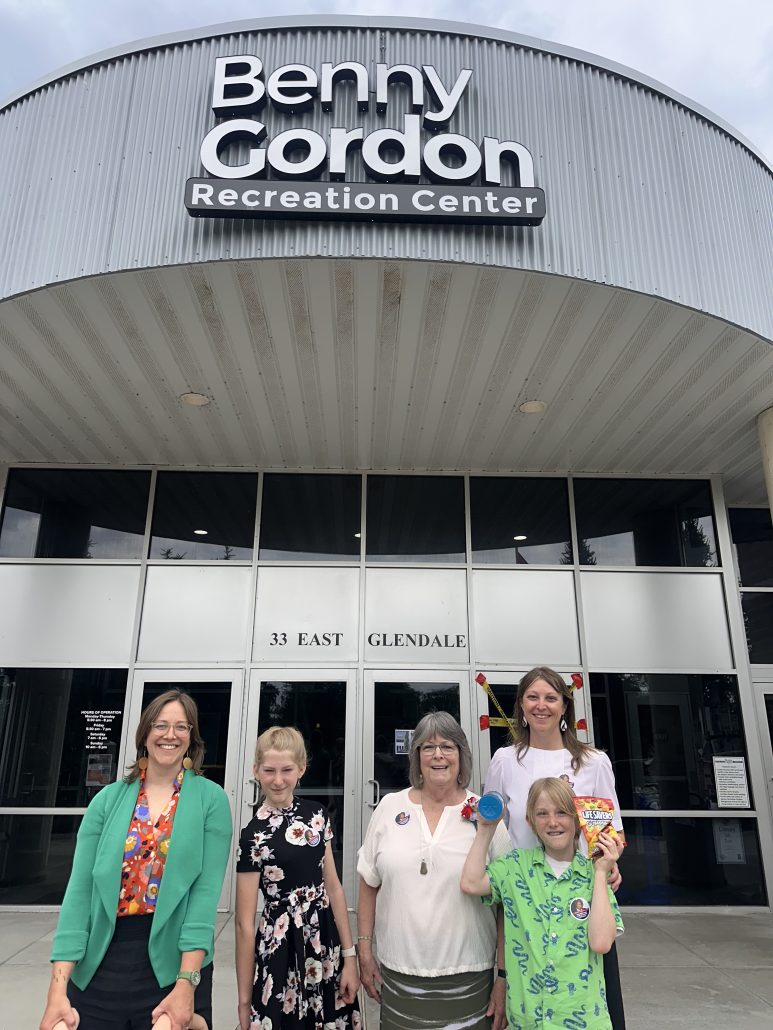
Webster, Missouri. Photo courtesy of the Waechter family.
As the Palestinian poet Mourid Barghouti writes:
“If you want to dispossess a people, the simplest way to do it is to tell their story with ‘secondly’.”
The author Chimamanda Ngozi Adichie continues this logic in her Ted Talk, “The Danger of a Single Story,” by offering this example:
“Start the story with the arrows of the Native Americans, and not with the arrival of the British, and you have an entirely different story.”
When I moved to Leelanau County, I picked up the local history pamphlet from Bingham Township Hall to learn a little more about this new-to-me place. As I cracked the cover, I was disappointed to read that the first line began:
“The white man’s first possible visit to this land of the Ottawa and Chippewa Indians is thought to be…” centering the “white man” in the story. The paragraph goes on to read, “the Indian tribes signed the Treaty of Washington giving the government the upper western portion of the state…”
To start the story with the pioneer families who arrived on the land erases the history of all those who lived and loved, who hunted and fished, who made art and sang, who grieved and died on this land before the white settlers came. To start the story with “secondly” erases the violence and land theft that occurred to make it possible for these settler families to make this area their home.
This land was not “gifted.” It was taken from a people whose descendants still live as our neighbors here today.
Our counties and townships in Northern Michigan were built by systematically shrinking Indigenous access to land through a series of laws—Allotment Act, Pre-Emption Act, Land Sales Act, etc.
What was once held by Indigenous people as common land—rooted in the idea that we are not separate from each other or the land itself—was, within a generation, converted to parcels for private ownership, ripe for fences and “no trespassing” signs. Where eventually, access to swimmable water would be greatly reduced, because “the closer to the Bay, the more you pay.”
In these consequential days of our nation, we are reckoning with what story we are going to claim about who we are. In a time when racism is becoming unabashedly explicit again, we must continue to call out current and historical racial violence.
As I returned home from Missouri this spring and mulled over our journey, I was left with immense gratitude for Mr. Benny Gordon Jr.
As he reflected in his later years on his military service abroad, he told the Webster-Kirkwood Times in 2002:
“We were drafted with the premise that we were fighting for democracy [elsewhere], yet we didn’t have it. If I could go thousands of miles from home to fight for an ideal, certainly I could stay here and make it happen.”
Benny insisted that we be a people committed to equity, justice, and inclusion. He insisted that our lives are connected to each other and should not be held separate. He understood this value to be central to the choices that we make as citizens and community members.
He knew that, to build a nation worthy of the democracy we claim, we would have to struggle for it and live by the philosophy:
“Things don’t just happen; people have to make them happen.”
This is what I am celebrating and willing to struggle for as we mark the 250th anniversary of this nation.
Note: We believe that a commitment to repair is more than words. My family has contributed to the Freestyle Pool Pass to support the ongoing work of ensuring that every person—no matter their race, gender, sexuality, physical ability, or class—are able to use the public pool in Webster Groves. In honor of Benny Gordon Jr., we invite those in our own community who have benefited from the exclusion of others inside the broader history of our nation to make a donation. Find a link to donate on the “Freestyle Pool Pass” Facebook page or via check, payable to Webster Rock Hill Ministries, 111 East Waymire, 63119; include “Freestyle Pass Fund” in the memo.
Reverend Lucy A. Waechter Webb is a politicized spiritual leader, somatic coach, mother, land-tender, ritualist, writer, and organizer. She works at the intersections of spirit, embodiment, and justice to support the emergence of our collective liberation. After 10 years as a pastor and community organizer, she is now focused on weaving together cultural change and organizing for material change, with the body at the center.
Benny Gordon Jr. (1923-2003) spent much of his life advocating for change and fighting discrimination in Webster Groves. A graduate of Douglass High School, Gordon helped to bring running water and natural gas service to his neighborhood in North Webster. He actively fought to integrate the local schools, in addition to the public swimming pool at Memorial Park. Gordon served in the U.S. Army during World War II in the 254th Tank Battalion, receiving two bronze stars, multiple campaign ribbons, and a good conduct medal. He studied at Balliol College at the University of Oxford in England and Biarritz American University in France, returning to form his own real estate and development firm, Benny Gordon and Associates, which he ran for more than 40 years.
A version of this article first published in the Glen Arbor Sun, a Leelanau County-based semi-sister publication to The Betsie Current.
Featured Photo Caption: Members of the Gordon and Waechter families with current and former City Council members in Webster, Missouri. Image courtesy of the Waechter family.
Leave a Reply