
Stories behind the names of Benzie County
By Syldee Brozofsky
Current Contributor
As the weather grows warmer and the trees greener, Northern Michigan becomes the destination of many vacations.
It is not unusual to find typically vacant homes on picturesque streets becoming full of life for the summer. The beaches fill with foreign faces and the streets with fancy cars and out-of-state license plates.
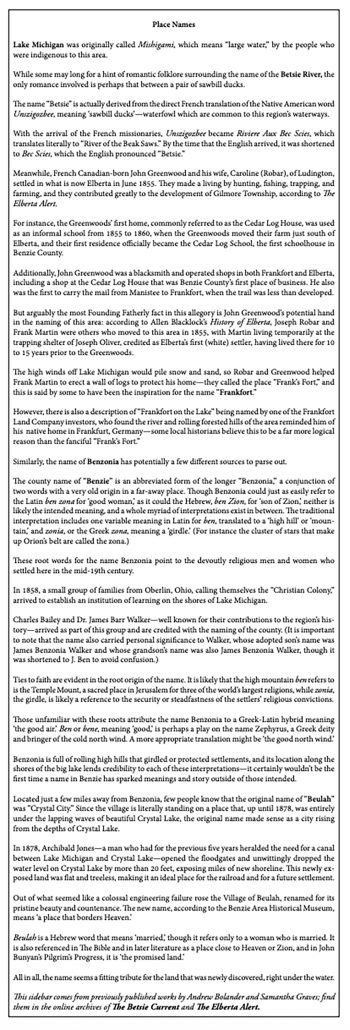
Many visitors to Benzie County will misspell the names of its towns when typing them into their GPS and ponder for a second, “Why would someone name a town that?”
At best, it may get a quick Google search and a cut-and-dry explanation, or—in most cases—it is forgotten the moment after autocorrect kicks in.
But for those tourists who are curious—and for the locals who want to know more—we at The Betsie Current have compiled a list of names and their origins, with the help of our friends at the Benzie Area Historical Society and Museum.
Even though many people will pass through our towns without any regard for the history they hold, it is important to make sure that it is within reach for anyone willing to look for it.
Also, notice that it is not unusual for a name to have many origins—the stories behind the names reflected here are to the best of our knowledge.
Thompsonville
Thompsonville lies right at the intersection between the Chicago and West Michigan and the Frankfort and South Eastern railroads—both no longer in use—otherwise known as the Diamond Crossing.
The historic railroads intercepted in a village originally platted as “Lyndonville,” because many of Thompsonville’s first settlers came from Lyndon, Vermont. One of those early residents was Sumner Shaw Thompson, an honorable man and member of the community who was born in Massachusetts and later moved to Vermont, before arriving in Benzie County sometime after the 1840s.
Thompson had just completed his work on the Woodstock Railroad and was promoted to the president of the Frankfort and South Eastern Railroad. When he died during the railroad construction in 1889, the village of Lyndonville changed its name to Thompsonville in honor of him.
Notably: Several years after the construction was completed, the Frankfort and South Eastern was absorbed into the Ann Arbor Railroad, while the Chicago and West Michigan was absorbed into the Pere Marquette Railroad.
Frankfort
There are several theories on how Frankfort was named. The most realistic story is about an investor in the Frankfort Land Company deciding to name it after his hometown of Frankfurt, Germany, due to the similar geography. However, many people bank on a more entertaining tale, following a fisherman.
Born in Pennsylvania in 1818, Joseph Oliver grew up to become a self-employed logger, woodworker, and trapper. Later on, he moved to Northern Michigan and became the first (white) settler in Benzie County. Joseph bought land between the Betsie River and Lake Michigan in 1852, where he established a trapping hut.
As the community of settlers grew, a fisherman named Frank Martin arrived in the area during the winter of 1855. Since the ground was frozen at that time, it would have been tedious and labor intensive to build a structure to stay in for the time being, leading Martin to temporarily stay in Oliver’s trapping hut.
Lake Michigan, of course, has a bone-chilling lake effect—especially in the winter. The average temperature at the time was unusually low, around 35 degrees Fahrenheit, colder than the following years, according to the Association for the Sciences of Limnology and Oceanography.
Oliver’s trapping hut was not ideal for these bitter winds, with its many cracks and gaps allowing the elements to seep inside. Some sources believe that these conditions prompted Martin to stuff every nook and cranny that he could find with leaves, moss, and mud, while others believed that he erected a wall made of logs to fortify the hut against the draft coming off the big lake.
When the other settlers saw Frank Martin’s patchwork attempt at keeping the frigid weather out, they began referring to the trapping hut as “Frank’s Fort,” which allegedly is the origin of the harbor town’s modern name.
Either way about it, the City of Frankfort was officially established in 1885.
Elberta
Sitting nearly parallel to Frankfort, but just across the Betsie Lake/Bay, Elberta has gone through a wild ride in the naming department. The Village of Elberta is the home of a rich history, with a small-town charm that can solely be found in the Midwest. It has garnered attention for its access to the historic Ann Arbor Railroad ferry route to Wisconsin, dating back to 1892, and the Frankfort Iron Works that housed the largest blast furnace in Benzie County.
In 1866, George M. Cartwright stumbled upon the land where modern-day Elberta now stands. Born in Grand Blanc, Cartwright was a businessman, associated with several industries across Michigan. He dabbled in the sales and shipping of Manufacture of Lumber, organized the Wisconsin Plaster Company, and was an agent for one of Michigan’s former governors, as stated by the Village of Elberta website. He was especially involved in real estate, and he often jumped between the “pinkie finger” of the Michigan mitten and then downstate to Fenton, his former home.
At the time, the U.S. Government was planning on starting a harbor installation nearby, and when Cartwright caught wind of it, he decided to begin developing the area of Elberta in preparation for the businesses and settlers that were sure to flood in.
To start, he hired George E. Steele, a civil engineer from Homestead [Township], to lay down the base for the town. Elberta was first platted as “Frankfort City,” and many of the roads were named after Cartwright’s friends and associates, including his civil engineer, Steele.
Further down the road, “Frankfort City” was incorporated as the ”Village of South Frankfort” in 1894.
After many years of being considered a branch of the City of Frankfort across the bay, a contest was suggested to rename the town in 1911. Andy Bolander, a knowledgeable volunteer researcher of the Benzonia Area Historical Society, says that the prize offered was “five dollars and a box camera.”
Ultimately, Ella Fox won with the name “Elberta,” inspired by the abundance of Elberta peaches that grew in the town at that time.
Notably: The Elberta peach—which is still today one of the most popular and largest-producing varieties of peach trees—was first introduced in Georgia in 1875 by Samuel H. Rumph after he crossed an Early Crawford and a Chinese Cling, which he later named “Elberta” in honor of his wife, Clara Elberta Moore.
Copemish
Copemish is a small village located just over the Benzie-Manistee county line, though many of its residents attend the Benzie County Central Schools system, because of the way that the school district lines fall—in fact, Betsie Valley Elementary is located just outside of Copemish and within Manistee County.
The name Copemish means “beech tree” in Anishinaabemowin, the language of the First Nations people of this area. The name references the Ojibwe tribe holding council under the beech trees.
However, there is not a beech tree to be found on Copemish’s Beech Street now; by the time of the town’s founding, white settlers had taken possession of the land and were already forcing the forest’s retreat.
At first isolated, the village was finally connected to transportation after a logging company laid a railroad directly through the center of it in 1891.
The town of Copemish was founded that year as a lumbering town but later was known for its pickle farms, after the forests were gone.
Lake Ann and Platte River
The town of Lake Ann—located in Almira Township—was first platted and surveyed during the 1860s. There were very few settlers to start, and those who were there for the first five years were given government deeds for their farms.
The first house in the area was built by Andrew and Almiral Burrell, who the township was later named after. Then, Addison and Ann Wheelock moved in next to the lake. Without any others to determine the names of landmarks, Addison Wheelock decided to name the lake after his wife, hence “Lake Ann.”
Recognized as one of Michigan’s Blue Ribbon Trout Streams, the Platte River begins out of Lake Ann and meanders through a few small inland lakes across Benzie County before emptying into Lake Michigan. The Platte River Watershed encompasses 193 square miles, and the river valley itself is 14 miles long, with a total of 90.5 miles of river and connecting streams. The mouth of the Platte River is found within Platte Township, located a bit north of Crystal Lake.
There is not a known story of how this river or its township came to be named, but the word “platte” could have been derived from the French word plat, meaning “flat” or “level,” according to the Benzie Conservation District, since the river’s gradient is very gradual, at approximately five feet of decline in elevation per mile.
Honor
The Village of Honor is located along the Platte River within Homestead Township. The name comes from Honor Griffin, the daughter of the village’s founders. The town had started as a frequently visited settlement for the Ojibwe and Chippewa Native Americans, almost like a vacation spot that tribes would migrate to for the summer.
As time passed, farmers and loggers flooded into the area looking for work and land. Honor has abundant forests and fertile soil, making it the ideal place for a village to flourish.
Honor was founded in 1895, and has continued to grow with the help of Coho salmon which draw in fishermen and the location which attracts retiring couples and nature-loving Michiganders.
Bendon
There is not a real “village” of Bendon; rather, now it is considered an “unincorporated community” and a “census-designated place” with a year-round population of 210.
Located within Inland Township, Bendon was initially named “Kentville,” in honor of Albert Kent, a hardworking farmer who became the first postman in the area in 1888. The post office was placed next to the Chicago and West Michigan Railroad—which later became a branch of the Pere Marquette Railroad.
Later, in 1892, the town renamed the post office to “Bendon” and was in business for another 62 years, before shutting down in 1954.
Syldee Brozofsky is a student at Frankfort High School. This is her first report for The Betsie Current newspaper.
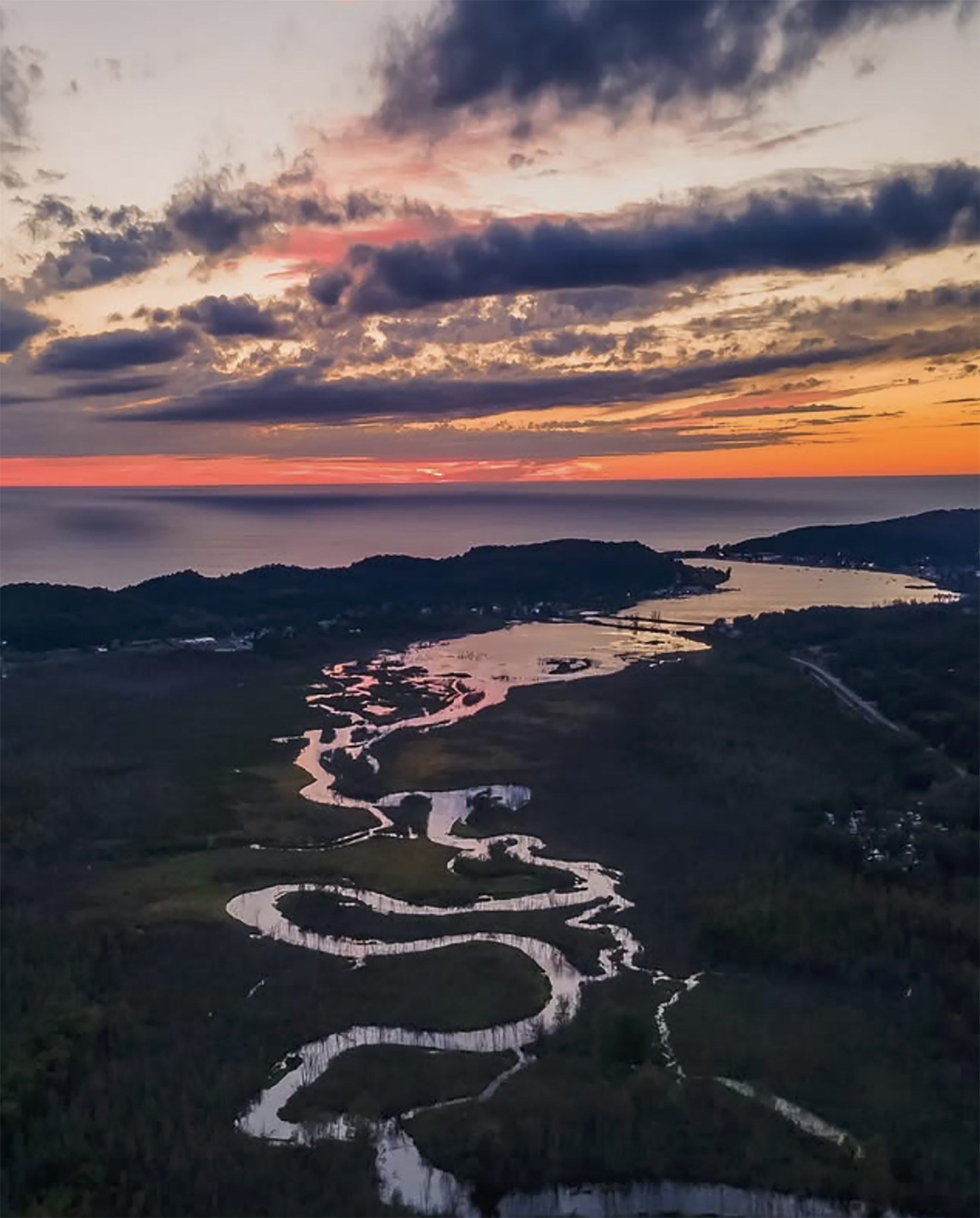
Featured Photo Caption: From (Lake) Ann, Bendon, and Copemish all the way to Thompsonville, we’ve got the ABCs of Benzie’s names! Photo of the Betsie River and Lake Michigan courtesy of Noah Sorensen.
Leave a Reply