Young mother utilizes innovative strategies to afford housing in Benzie County
By Aubrey Ann Parker
Current Editor
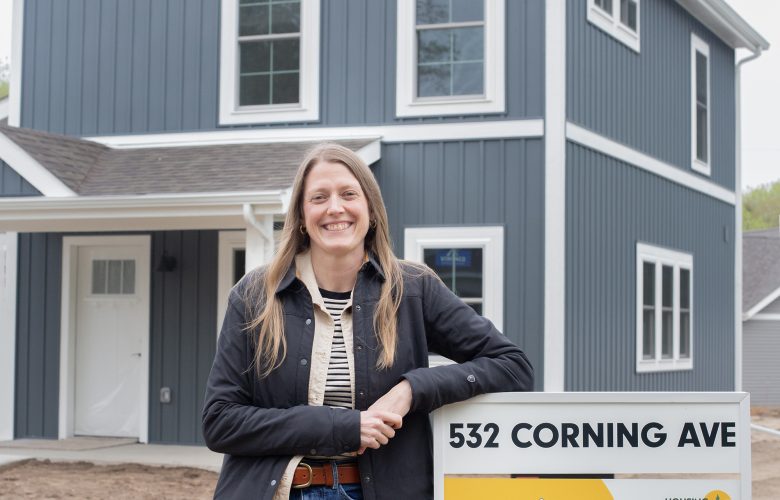
Ainsley Stapleton (25) is a mother, an aspiring nurse, and now a homeowner—but she definitely took the path less traveled to this last title.
“I call it ‘Project House’,” Stapleton says of the fixer-upper that she has been working on, in some capacity, since early spring of 2025. “It’s been vacant and an eyesore for several years… it was supposed to be torn down, because it was in such bad condition. It was full of mold; disgusting, truthfully.”
When some family friends first brought this house to Stapleton’s attention, her initial thought was: “Nope.”
“As a then-24-year-old with multiple jobs and a kid, I just thought, ‘I am not in a place in my life where I can buy a project house; it’s not something I can do right now’,” she recalls.
But then, a lot of things began falling into place, and Stapleton decided to take a second look.
Most people think buying a home is about saving up a down payment and then heading to a bank to secure a 30-year mortgage, and much of the time, it is—but not so in Stapleton’s case.
From front to back, Stapleton’s story of home-ownership has involved a lot of outside-the-box thinking, creative strategizing, persistence, and fortitude, as well as a myriad of funding models and mutual aid, to bring this 50-year-old home back from a death sentence.
Getting Started
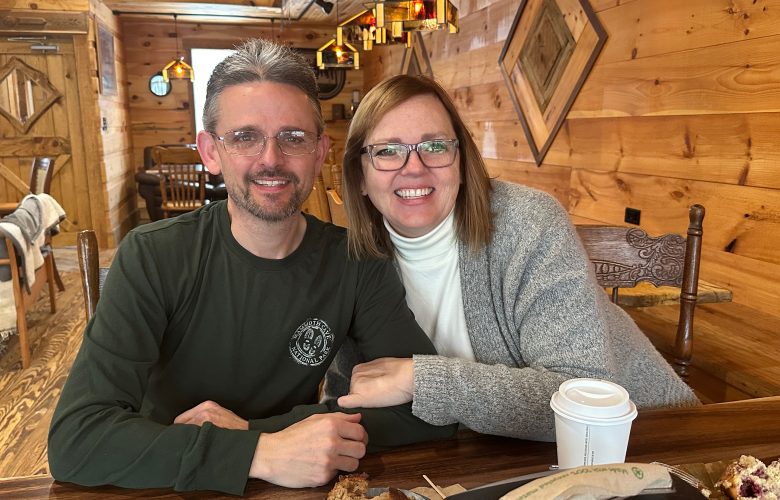
“It started with us having a conversation. We were just talking about how her life was going,” says Julie Orr (54), who has known Stapleton since she was born. Additionally, Orr and her husband, Jonathan Clark (66), own L’chayim Delicatessan, where Stapleton has worked on and off for years.
Stapleton was renting at the time, but she expressed an interest in home ownership, “you know, down the road.”
Orr and Clark mentioned an abandoned house they had seen in Benzonia—Stapleton told the couple that she was well aware of the house, since her paternal grandmother lived next door. As the mother of a then-toddler, Stapleton feared that the house would be too much work.
“We told her that we love to do projects like that, we love to get people into a house,” says Orr, who together with Clark owns three long-term rentals for year-round locals. “We’ve never completely redone anything, but all of our properties have needed love.”
Clark adds:
“Our whole thing is to try to keep local people in Benzie County. Not only that, but their children. So maybe that talent pool of ours doesn’t keep disappearing every year after year after year. And if they do leave, at least they have a keyhole that they can always come back to Benzie County, because we’re losing them left and right. The housing thing is a mess.”
At this point, Stapleton was still hesitant—especially when she heard that it was full of black mold—but the idea kept percolating in her head.
Good Bones
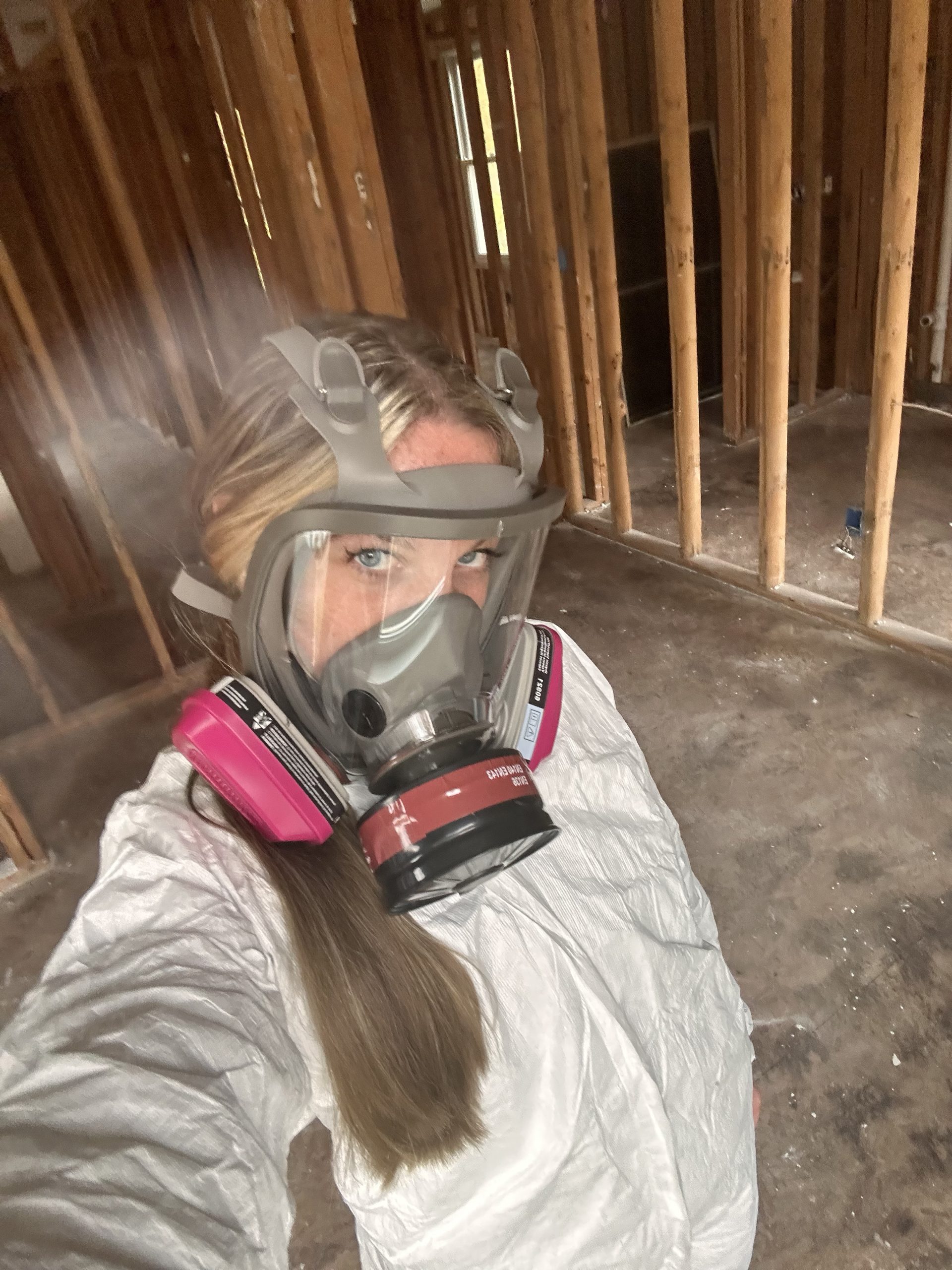
Built during the 1970s within the Village of Benzonia limits, Project House has three bedrooms with one and a half bathrooms. Over the last year, the house has undergone black mold remediation four times, as well as air treatments, testing, and wood sealing. The electrical and plumbing were recently finished; the drywall and paneling are going up now.
“It looks entirely different,” Stapleton says.
But this home was almost torn down completely.
“We have never had a building like that,” says Michelle Thompson (61), former executive director of the Benzie County Land Bank Authority, who before that served as the Land Bank’s chair for 12 years while she was Benzie County’s treasurer; Thompson now serves as director of the Michigan Land Bank Association, which supports 56 land banks in Michigan, including ours here in Benzie. “It had problems, which is why the owners abandoned it. Lots of mold. Everybody thought it would have to be demolished, so our first plan was to gain control of that property and seek demolition, so we started down that path.”
According to Thompson, the county treasurer’s office had been trying to collect taxes on this property for many years. The home owners had a mortgage on the house through the USDA Rural Development office, while the land was owned by Homestretch Nonprofit Housing Corporation, a Traverse City-based nonprofit organization that has been developing affordable rental and homeownership opportunities for low- to moderate-income residents in Antrim, Benzie, Grand Traverse, Kalkaska, and Leelanau counties since 1996.
The Benzie Land Bank bought both the house from the homeowner and the land from Homestretch to put the two pieces back together.
Typically, a land bank accumulates tax-forclosed properties and offers these up for auction to the public. But in Benzie County, according to Thompson, we have a very low stock of tax-foreclosed properties with homes on them, so our Land Bank was acquiring this moldy house in Benzonia via a different method.
“We bought it for $1,000 [from the home owner],” Thompson says.
Ultimately, when the Land Bank sought a quote for demolition, they were told: “Why are you demolishing this perfectly good home? You can get rid of the mold.”
Thompson continues:
“I just never envisioned it. But it made me think, ‘Okay, maybe I need to start asking different questions.’ So we began down another path and got a quote for mold remediation.”
At this point, the Land Bank put the property up for bid, stipulating that the house must be remediated within 18 months and that it must have full-time occupancy—it could not be used for short-term rentals, for instance.
This is when Stapleton saw a notice in the Benzie County Record Patriot about the bid process—serendipitously just weeks after her conversation about this same house with Orr and Clark.
“We had just kind of dropped the idea, after we heard about the mold,” Orr says. “And then two weeks later, she texted me and said, ‘You won’t believe this.’ She sent me a picture of [the notice in the newspaper of] the Land Bank having this house up for bid. I told Ainsley, ‘Come over and let’s talk about. We’ve never done anything like this before.’ I didn’t even know what the Land Bank was, but we could read through it and talk about how we might get involved.”
Stapleton wrote up a detailed proposal in consultation with a contractor, who helped her through a six-page breakdown of materials needed, estimates of what things would cost, and a proposed timeline. Meanwhile, Orr and Clark wrote a letter of support, and a few other people wrote letters of recommendation, too.
A few days before submitting the sealed bid, they were allowed to tour the house.
“Dear God,” Orr laughs. “We went in, and I remember looking at her and saying, ‘Does it scare you?’ My ex worked on restoration projects, so I knew it could be done, but I didn’t know how she felt. But she said, ‘I’m not scared at all. This is a challenge’.”

Stapleton and Clark then attended a meeting with the Land Bank’s board, in which she had to present herself and talk about why she wanted Project House.
“The Land Bank really wanted somebody that was local, somebody who needed affordable housing,” Orr says. “They didn’t want it to be a ‘flip,’ they didn’t want it to become an Airbnb.”
There were four applicants, but Stapleton’s $20,000 bid won out in the end.
There have been about $20,000 in additional renovation costs since that time, as Stapleton has worked on submitting a mortgage application through the USDA Rural Development office—the mortgage will cover the rest of the renovation costs and pay back her benefactors.
Rural Financing
Most people in the United States who are looking to obtain a mortgage go to traditional commercial banks, dedicated online lenders, credit unions, or mortgage brokers.
But parts of the country—including many areas in Northern Michigan—also qualify for mortgages from the U.S. Department of Agriculture (USDA) Rural Development.
“We used to put maps of eligible areas online, but it was often difficult to determine which side of the line a specific property was,” says Alec Lloyd, the public information officer for the USDA Rural Development in Michigan, based in the main office in East Lansing.
Having worked in this office for the past two decades, Lloyd has seen the systems upgrade from downloadable PDF map files and paper filing cabinets to digital files and online applications.
Now, he says, it is easiest to log onto the USDA Rural Development website and plug in an address to see if the location would qualify.. That being said, he believes that all of Benzie County is defined as ‘rural’—at least right now.
There are three types of USDA Rural Development loans:
• Single Family Housing Direct Loans: For low-/very-low-income applicants to buy, build, or repair homes with no money down. Funds come from USDA.
• Single Family Housing Repair Loans and Grants: For repairs to remove safety hazards for elderly or low-income homeowners. Funds come from USDA.
• Single Family Housing Guarantee Loans: Almost identical to Veteran Administration (VA) loans, but only applicable to rural areas. Funds come from a conventional lender; not all lenders participate.
To qualify for a USDA Rural Development loan, individuals must meet the income requirements—typically less than $119,850 for four-person households in Michigan—and houses must be a location within eligible rural areas.
In the U.S. government’s fiscal year 2025—which ran from October 1, 2024, to September 30, 2025—Benzie County had two direct loans and two guarantee loans, of the total 267 direct loans worth $21 million and 903 guarantee loans worth $170 million in the entire state.
The direct program is limited to the funds appropriated by Congress, Lloyd says, whereas the guarantee program is more wide open, because the loan funds come from the lender and—just as with VA loans— the government provides a guarantee to the lender in case of a default, which lowers borrowing costs.
The government shutdown back in October and November 2025 caused “some disruption and backlog,” according to Lloyd. The voicemail and email systems were still working during the shutdown, but employees were not able to check them until Congress passed a budget to fund USDA through the rest of the fiscal year, which ends in September 2026.
“When we came back, we had quite the inbox, as you can imagine,” Lloyd says.
Stapleton is one of those people who originally had planned to submit her direct loan application back in November, but was unable to do so, because of the extended government shutdown at that time, when no new loans were being processed. She still had some nuts and bolts to figure out, but she eventually turned in her application in February and is currently waiting to hear if she has been approved.
Gap Financing
Property prices are booming in Northern Michigan—and in Benzie County, especially.
So, what happens when someone qualifies for a $250,000 mortgage, for example, but they cannot find a house for sale for less than $260,000?
This is a real problem facing many potential home buyers, and now there is a Northern Michigan nonprofit looking to help bridge that “gap” in the financing.
Home Sweet Home—incorporated as a nonprofit in 2024—could provide the additional $10,000 needed in the above example as a zero-interest loan, with the homebuyer signing a deed restriction agreeing that, when they eventually decide to sell their house, it would go to “another family earning modest wages.”
“We won’t get out of this housing crisis just by increasing the number of new builds,” says John O’Neill, co-founder and current secretary for Home Sweet Home. “We need to preserve the existing homes.”
He told The Ticker back in February 2023:
“This method can preserve three to five homes [for local buyers] for the same cost of building a new home.”
In this way, Home Sweet Home’s agreement with home buyers helps to ensure that these houses remain as primary residences, rather than short-term rentals, and that they are reserved for low- or middle-income buyers.
O’Neill is nearing his fifth decade working in this space—he first volunteered for a few days with Habitat for Humanity during the 1980s while visiting the lower east side of Manhattan. His family had lived in New York, but by this point, they had moved to Michigan, and he loved the work so much that he volunteered for a couple of years before following an unconventional path employment with Habitat back at home.
“They said, ‘Well, we’re not hiring, but if you can find somebody who’d pay you to work for us, we’d be happy to let you work’,” O’Neill recalled to The Ticker. He says that he wrote to 250 of his closest friends and family, asking them to pitch in $10 to $25 per month.
This can-do attitude worked: O’Neill was then employed by the Habitat office in Lake County, back when there were only affiliates in Michigan. Since that time, he helped to establish and then ran Habitat Grand Traverse Region as the organization’s first executive director; worked as innkeeper and grant writer for Goodwill Inn; served as executive director of the Benzie Housing Council; ran for local office in Leelanau County, where he pushed for affordable housing; and served on the Leelanau County Housing Action Committee.
His latest endeavor, Home Sweet Home, was cooked up with co-founder Jason Potes (50), current board president and a credit specialist with Eastwood Custom Homes, who also worked for the Benzie Housing Council.
Potes told O’Neill that he knew of “at least 10 families with good credit and decent earnings” who were camping in tents during the summer of 2022, because they had been living in houses that were long-term rentals during the winter and spring, but these families then were turned out for the summer short-term rental frenzy, according to The Ticker’s reporting.
This is an all-too-common cycle for many local folks: moving every six months or so, as the tourist season comes and goes in Northern Michigan.
“These families don’t have stable living situations, and living homeless part of the year has such a negative impact on their lives—on their kids especially,” O’Neill told The Ticker.
At only 25, Stapleton has been mostly lucky in her previous rental arrangements.
“I am fortunate enough to have a large family that is very established in Benzie County, so that has benefited me for the places where I’ve rented basically since high school, because it’s pretty much impossible otherwise,” she says. “Because of all of these summer-time rentals and partial-year rentals, and I dealt with some of that, too. But I was fortunate enough to know the right people, find something by ‘word of mouth,’ but even that—you get caught in this cycle of renting and not affording to put enough away for down payment.”
Right around the time that Stapleton—with the help of Orr and Clark—had acquired Project House and was starting to think about formal financing options, O’Neill walked into L’chayim in Beulah.
“So we just told him our story and what we were trying to do,” Orr says. “He and Jonathan [Clark] got talking, and he thought it was fascinating. He said it sounded different from the gap financing that they normally do, but it might be right up their alley, and he thought they might have some resources. He also was the one to suggest the USDA mortgage route.”
Over the past year, Home Sweet Home has helped four new homeowners with gap loans for a total expenditure of just under $35,000 from donors.
“When someone with modest income is shopping for a mortgage, we encourage them to go to the USDA Rural Development,” O’Neill says. “They should already have gone to them and to [Northern Michigan Community Action Agency, NMCAA], which has a down-payment-assistance programs and covers Benzie, Leelanau, and Grand Traverse counties, which is [Home Sweet Home’s] service area. Because all of that needs to be done before we come in to help.”
O’Neill notes that USDA Rural Development direct loans can offer first-time home buyers an effective interest rate as low as 1 percent with no down payment; previous homeowners may also qualify. Likewise, the Individual Development Account through NMCAA can match $1,000 with up to $3,000 for a down payment.
In the meantime, when it comes to Project House, Home Sweet Home has set aside $2,600 for Stapleton to help with costs, while she has been working on the house and waiting for USDA Rural Development mortgage approval. Additionally, Potes was a big help with the USDA application process.
“Home Sweet Home has really great resources for landscaping and painting, which will be super helpful and is just one more thing off my docket,” says Stapleton, who has regular meetings with the Home Sweet Home board. “There are a bunch of people trying to help any way they can. We’ve been getting grants, nothing crazy—but anything has been really helpful.”
Hand-Up, Not Hand-Out
The agreement that Stapleton has with the Benzie County Land Bank Authority states that the house must be in livable condition within 18 months of the purchase agreement.
“So I think we’ll hit that,” Stapleton says. “May marked 12 months, so I should be in by 18 months—or even before that, at this rate.”
Many hands have worked on this project, both literally and financially—a community of faces have helped with many facets of the project.
Orr emphasizes the importance of checking all of the boxes when it came to the mold-remediation portion of the project:
“We’re putting in a young lady and her kid, and we want to make sure [the mold] doesn’t come back on them.”
The electrical and the plumbing have all passed inspection.
Stapleton has ordered cabinets and flooring, and some things have been reused from Orr and Clark’s previous projects: for instance, they pulled the flooring from the Frankfort L’chayim location, which was being redone, as the deli is moving down the street and the old space will be filled by an art gallery in just a few months.
“She’s going to use that flooring,” Orr says. “Things that can be repurposed. This whole thing is a project.”
A year in, Project House has been a lot of work.
At first, Stapleton was reluctant to ask for help; Orr and Clark say that they really had to push her when it came to applying for various available funding, such as grants. For instance, Stapleton chose not to apply for help from St. Andrews Missionary Project (STAMP) this year, despite that she met many of the criteria.
“I don’t want to take advantage, when there might be someone else who really needs this,” says Stapleton, who is a nursing aid at Munson in Traverse City and is working toward her nursing degree through Kirtland Community College.
Clark says he often reminds Stapleton:
“This is a hand-up, not a hand-out. People want to help you, to help young people to get into affordable housing. We know that it’s ridiculous here in Benzie County, and we want dedicated young people to be able to stay and work here and raise their families here and better our community.”
He adds:
“Who knows, if this thing works, maybe we’d do another [Project House]. Maybe we want to keep supporting this kind of thing.”
Want more information on land banks? Check out MILandBank.org online. For more information on how to volunteer or to donate funds to Home Sweet Home, call John O’Neill at 231-835-0733 or email JohnONeillBackup@gmail.com. To learn more about USDA Rural Development loans, visit RD.USDA.gov/programs-services/my-rd-loan-portal online.
Featured Photo Caption: Ainsley Stapleton (25) is a mother, an aspiring nurse, and now a homeowner—but she definitely took the path less traveled to this last title. Pictured here, Stapleton dressed appropriately in what she is calling her “Project House” in Benzonia. Photo courtesy of Ainsley Stapleton.