Thomas Paine celebrations in Benzie County
By Ed Hoogterp
Many folks in the 13 Colonies were just fine being ruled by a king 250 years ago, so long as their English monarch did not interfere too much in their lives.
But Thomas Paine saw it differently. To him, it was “common sense” that people everywhere should choose their own leaders—and that hereditary royalty was both “absurd” and “evil.”
“Exalting one man so greatly above the rest cannot be justified on the equal rights of nature,” he wrote in his famous pamphlet Common Sense, which was published in January 1776—six months before the Declaration of Independence.
Paine has been called “The Father of the American Revolution,” but his place in history is often obscured by the nation’s affection for George Washington, Thomas Jefferson, Benjamin Franklin, and other “founding fathers.”
As America approaches the 250th anniversary of the Declaration of Independence later this summer, a new generation is discovering how Paine’s writings contributed to the Declaration and to the U.S. Constitution—as well as to our understanding of 21st-century issues.
Born in Britain, Paine attended school until age 13, when he began an apprenticeship with his father, who was a tenant farmer and a staymaker, who crafted corsets. He then served on a privateer boat for a short time, before becoming a master staymaker and opening his own shop. He married at the age of 23 but soon was a widower, when his wife and child both died in early labor. Paine then worked as an excise officer, collecting taxes for the Crown.
At the age of 32, he became first a teacher, then a husband again, and then a grocer and tobacconist in Lewes, a Sussex town known for opposing the monarchy for nearly a century before he arrived—and this is when Paine’s pro-democracy beliefs began to set in and when he began writing his ideas down to publish.
Known for advancing Enlightenment-era arguments for human rights, Paine first immigrated to the British American colonies in 1774 at the age of 39—notably after his tobacco shop failed, he was forced to sell all of his household possessions to avoid going to debtors’ prison, he formally separated from his second wife, and he met Benjamin Franklin.
Printed pamphlets, such as Common Sense, were in some ways the “podcasts” of the late 18th century—widely distributed among the populace and read aloud in homes, schools, and taverns. At only 47 pages, Common Sense called specifically for a Declaration of Independence from Great Britain and for creation of a republican form of government.
It sold as many as 500,000 copies in the colonies, which had a population at the time of some 2 million, only about half of whom were literate—in other words, Common Sense was widely popular and easy to read.
Originally titled Plain Truth, the pamphlet offered Americans a solution to the threat of tyranny: reject King George III and unite in the spirit of liberty.
Unlike his peers, Paine’s informal writing style made complex ideas easy for the average reader to understand—true to its name, Common Sense was meant to be common sense.
In later years—after he had returned to Britain in 1787, then fled to France in 1792—others of Paine’s pamphlets, The Rights of Man and The Age of Reason, were also instrumental in the French Revolution, which deposed that country’s king, as well.
Despite his accomplishments, however, Paine was often controversial—he was charged with sedition in England, was imprisoned and briefly faced the guillotine in France; and ultimately, only six people attended his funeral on June 8, 1809, seven years after he had returned from Europe to the United States of America, which he had helped to create.
Simply put, though Common Sense had proved popular during its peak, Paine himself was not popular by the end of his life at the age of 72.
In those early American days, he was criticized by his contemporaries for radical proposals—such as his opinion that even men who owned no property should be allowed to vote—as well as his religious beliefs.
Historians today generally classify Paine’s religious philosophy as “Deism,” similar to that espoused by Thomas Jefferson—at the time, many considered this philosophy to be anti-Christian. (Paine’s mother had been Anglican, and his father had been a Quaker.)
In one of his many incendiary comments, linking monarchy and Christianity, Paine wrote:
“The Heathens paid divine honors to their deceased kings, and the Christian world hath improved upon the plan, by doing the same to their living ones.”
Here is how he described his own theology in The Age of Reason:
“I believe in one God and no more; and I hope for happiness beyond this life. I do not believe in the creed professed by the Jewish church, by the Roman church, by the Greek church, by the Turkish church, by the Protestant church, nor by any church that I know of. My own mind is my own church…”
In the end, though, much of Paine’s words continue to hold value for modern-day Americans.
Paine’s most oft-quoted passage comes from The American Crisis, a pamphlet produced during the American Revolutionary War in December 1776:
“These are the times that try men’s souls: The summer soldier and the sunshine patriot will, in this crisis, shrink from the service of their country; but he that stands it now, deserves the love and thanks of man and woman. Tyranny, like Hell, is not easily conquered…”
George Washington had those words read to his troops during the bitter winter of 1776, and the passage was credited with improving the Continental Army’s morale during one of the darkest periods of the Revolutionary War. (Notably: Two decades later, Paine published an open letter in which he criticized Washington as incompetent and a hypocrite. Can’t win ‘em all.)
Thomas Paine’s life and work will be commemorated locally from 6-8 p.m. on Monday, June 8, with a film, potluck, and discussion at Grow Benzie, located at 5885 Frankfort Highway/M-115 between Benzonia and Frankfort. The event—sponsored by the Elberta Heritage Center—is part of a national recognition of Tom Paine Day, the anniversary of his death in 1809.
Also in June, Common Sense book discussions are scheduled for Monday, June 15, at 5:30 p.m. at Benzie Shores District Library in Frankfort and Thursday, June 25, at 6:30 p.m. at the Elberta Heritage Center.
All events are part of the local America250 recognition, co-sponsored by the Elberta Heritage Center, WUWU low-power radio station, and community partners, like The Betsie Current.
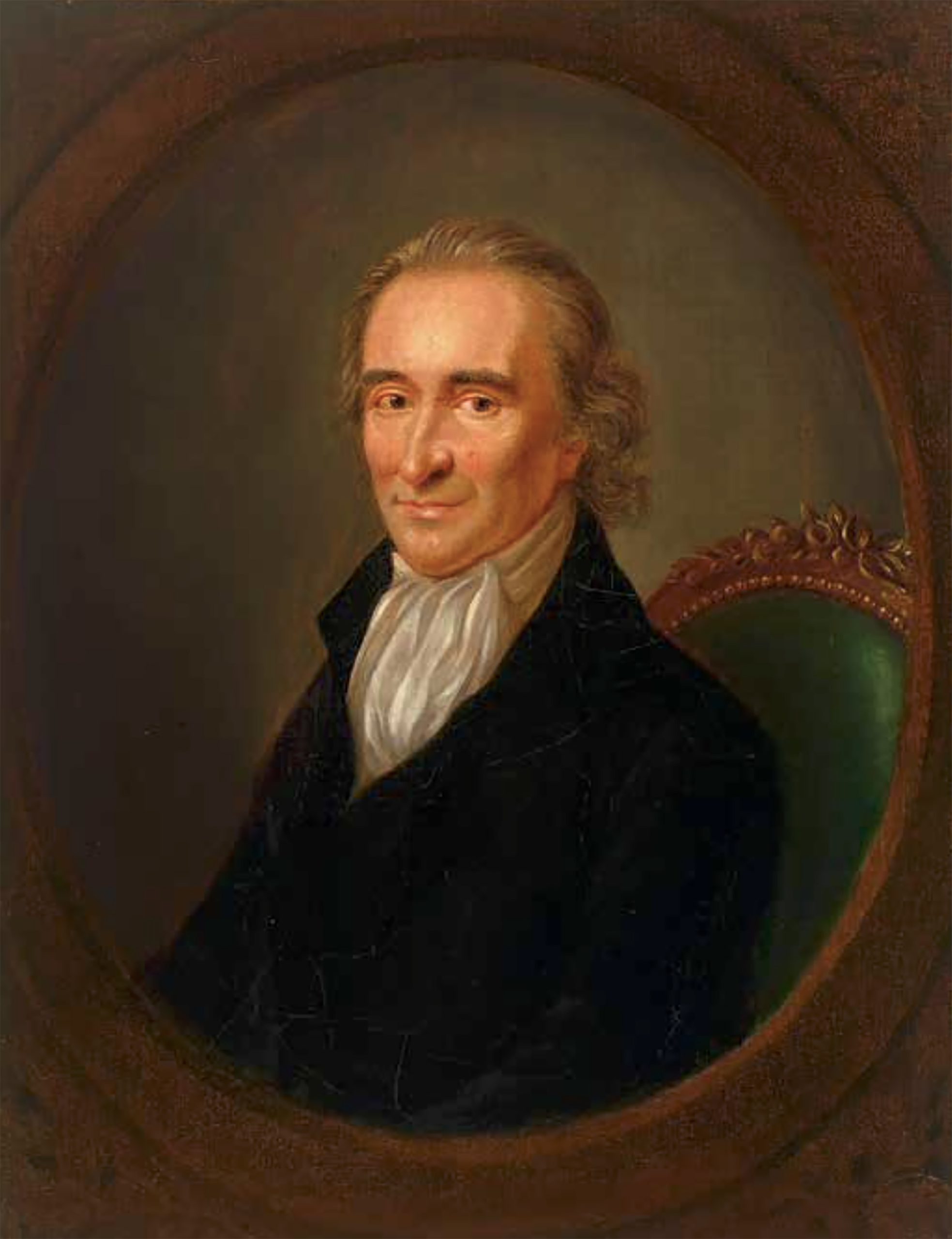
Featured Photo Caption: Thomas Paine portrait by Laurent Dabos, circa 1792. Image courtesy of Wikipedia.