Local and state-led initiatives to get venison into food pantries
By Aubrey Ann Parker
Current Editor
“I’ve asked around the last couple of years, and I just didn’t have any luck,” says Grant Cole (41), of Bear Lake, who has been hunting deer for 25 years.
He is not referring to his luck in shooting a deer; rather, Cole was looking to donate the deer meat—known as venison—to a local food pantry.
“There are other areas in the state where you can just drop the deer off, and they take care of it,” Cole explains. “I called BACN [Benzie Area Christian Neighbors], and they said that they could take it, but it needed to go through a USDA-certified processor, and they didn’t have anyone to cover the processing fee.”
Cole is correct that there are several different programs and individual processors throughout the state that help to get venison into local food pantries, but here in Northern Michigan, and specifically in Benzie County, there is currently not a centralized program to make it easy for the hunter—though that might be changing in our nearby area.
For instance, starting this year, the Empire Area Community Center was able to raise enough funds to cover the costs to process 50 donated deer, with the meat being donated to the Empire Area Community Food Pantry, which is run out of the Glen Lake Church in Burdickville. Called the Harvest with Heart Deer Donation Program, the venison will be processed at Buntings Cedar Market.
With deer season ending in just a few short weeks, as of the printing of this article, there have been 18 deer donated to this program so far.
Could a similar program be set up in Benzie County next year? Would our hunters even donate? Cole seems to think so.
“I think there are a lot of hunters who would donate deer,” he says. “Especially if the costs to the hunter were covered. Because costs to the hunter are going up all the time. A doe tag is $20, and the processing can be $150, so if the processing was paid for, I think people would be a lot more likely to donate.”
Only 1 to 2 percent of the deer harvested every year across the nation are donated, according to Farmers & Hunters Feeding The Hungry, a Maryland-based nonprofit organization.
Here in Michigan, though a record number of deer were donated last year overall, it still amounted to less than 1 percent of the 287,681 deer that were harvested during the 2023-24 hunting season; Benzie County made up 1,410 of those deer, with fewer than a couple dozen donated.
Deer Donations
Here in Benzie County—where approximately 2,000 of our 18,000 year-round residents face food insecurity—food pantries are seeing an ever-increasing need.
For instance, BACN has reported a substantial increase in the number of households needing assistance; just last month, the organization told Up North Live that they expect to serve 1,000 households this year, including 150 new households, one-sixth of which came in during the federal government shutdown, when SNAP benefits were suspended and people were out of work.
On average, about one to three deer are donated each year to BACN, according to Diane Mahoney, BACN’s executive director.
“We do field calls from hunters every year who wonder if they can donate to us,” she says. “There has definitely seemed to be more interest this year, but I can’t say for certain if it has resulted in more deer being donated.”
She notes that BACN can only receive food that has been processed by a USDA-licensed facility, and they need to be labeled as such.
She adds:
“I have also learned from Liz [Ham], our programs director, that we have received calls from people about using deer that have been struck by cars. Typically, USDA-approved meat processors do not accept these deer, but I can’t say that for certain. The best bet would be to contact them directly.”
Part of the problem, however, is not just the cost to process the deer, but also the space that frozen venison takes up: each deer equates to roughly 50 one-pound bags of ground venison, each roughly the length of your hand and the width of your thumb—that equates to about one-third to one-half of an average chest freezer, which can add up quickly.
At Benzie Food Partners in Honor, they have already had two deer donated earlier this hunting season.
“We have a couple of guys who are regulars for us,” says Jeffie Lynch-Jones, secretary and treasurer of Benzie Food Partners for the past 28 years, since it first began. She has never missed a distribution day. “Over the last 10 years, we’ve had some [deer] donated. Mostly from just the same couple of guys. They’re regulars who are familiar with us, and they give me a call when they’re done hunting.”
Meanwhile, this is the first year that the Fresh Wind Christian Community food pantry has received venison.
“We’ve received five deer so far,” says Diane Eldridge, food coordinator for Fresh Wind’s food pantry at the Thompsonville campus. “Which is a huge blessing. Four came from the same person, and one from someone else.”
In all three cases above—BACN, Benzie Food Partners, and Fresh Wind—the hunters have paid the processing costs.
There is also at least one processor in Benzie County who is donating his time, so that hunters do not have to pay the costs to donate their deer.
Terry Conger (61) has been butchering for 25 years, and he has owned his own business, T.C. Butchering, for the past 18 years. Located two miles north of Lake Ann, T.C. Butchering is located very close to where the Benzie, Leelanau, and Grand Traverse counties connect on a corner.
“So far this year, I’ve probably had close to 20 come in that we’ve run through the shop and donated out,” Conger says. “Hunters bring them in. We process them and send them off to different food pantries that I’m affiliated with: the Buckley Tabernacle Church, and we just started with a new one up in Leelanau County; we’re just finishing the paperwork.”
Conger adds that he has also found individual families in need and taken the venison to them.
“It all stays local, right here,” he says. “It may not always be Benzie, but it will stay within a 50- to 75-mile area of Northern Michigan, and that’s what I like.”
When asked why he chooses to donate his time in this way, Conger says:
“I’m a two-time cancer survivor, and it’s made me look at life a little bit differently. I finally have gotten to the point in my life where I’m financially secure, to where I don’t need to worry about money too much anymore. And I just want to start giving back.”
At around $150 per deer in processing, that is thousands of dollars each year in his donated time; it is no surprise that not every processor is willing to be this generous.
So is there a way to link up hunters, local food pantries, and willing processors in a way that means none of these has to take too big of a financial hit?
Where there is a will, there is a way—and a model to prove it.
New Empire Initiative
A collaboration between Buntings Cedar Market, the Empire Area Community Center (EACC), and the Empire Area Community Food Pantry could provide insight.
A total of 18 deer—and counting—have been donated by local hunters to the new Harvest with Heart Deer Donation Program in Empire. The initiative is financially supported by donations through EACC and its new Basic Needs Initiative Fund, which launched during the federal government shutdown and pause in SNAP benefits.
“This is a very encouraging report and will go a long way toward meeting our goal of harvesting 50 donated deer to assist in feeding fine folks in need within our community,” EACC president Gerry Shiffman told the Glen Arbor Sun last month.
Donated venison is being processed at Buntings and given to the Empire Food Pantry, which is run out of the Glen Lake Church in Burdickville.
Monica Bright (49) is the fresh meat manager at Buntings; she has been doing this for 35 years, having started at the age of 14.
“This is our first year participating in a program like this,” she says, noting that deer must be skinned before they can arrive at Buntings. “There are two locations that can skin them for us, and we can direct hunters to them, if they call ahead of time. I’m willing to accommodate as many as we can, and we’re still taking donations through the entire deer season. We haven’t reached their quota just yet.”
When asked why this program is important for our area, she says:
“It’s a good thing for people to do for others. Obviously in the world, nowadays, things are not the same as they once were. And so it’s a good feeling to know that there are people who are out there who want to give to others in need. It’s a good program, and a good thing to do.”
The program could still accommodate 32 incoming deer, as of the printing of this article.
“We’ve received eight of the processed deer, and we’re starting to get them distributed,” says Steve Murray, the lead coordinator of the Empire Area Community Food Pantry; he also serves on its board.
Murray adds that they are getting additional support from Cherry Republic, which has donated freezer space.
“We’re a small pantry, and we’re a nonprofit; we don’t have any paid staff or anything,” Murray explains. “We serve about 35 families a week, which is anywhere from 95 to 115 people. We try to give a week’s worth of groceries at a time.”
He says that their partner, the EACC, has committed to helping to fund processing for up to 2,500 pounds of venison, which would be around 50 deer this season.
“When the government shutdown happened, we did get an uptick of about 33 percent over a two-month period,” he says. “We seem to have more people coming, which we do get during the winter time anyway, because of seasonal businesses laying folks off. But we’re concerned about making sure that we have enough for everyone, because some of our suppliers have been affected by legislation, making it harder for us to get certain things into the pantry. I gotta say, hats off to different organizations and the community; they seem to be stepping in to fill the gap and to continue to supply what we need.”
The recent influx of high-quality meat from local hunters is a new boon.
“We’ve gotten a few [deer] donated in the past, but we weren’t coordinating it like we are this year,” he says of the new streamlined process. “We really saw a need, and people in the community informed us about this possibility. We advertised it a little more with the help of the [EACC]. Gerry [Shiffman] really helped us to step up the organization and scale of the deer harvesting.”
Nearly 20 Years of Programming
Back in September 2005, then-Michigan Governor Jennifer Granholm (D: 2003-2011) signed Public Acts 116 and 117 into law, at the same time as Public Acts 110, 111, and 112; the bills were all sponsored by Republican state senators and representatives. The first three of the five-bill package prohibited computer-assisted shooting with a crossbow or firearm—known as “remote shooting”—while the last two established a new government-funded program.
Run through the state’s Department of Natural Resources (DNR), the Hunters Feeding Michigan program encourages sportsmen and sportswomen to donate two different ways—the first is a voluntary $1 donation added to the price of a hunting or fishing license to pay for the program, and the other is donating legally taken wild game for use in food pantries. The majority of the cost for this program is to pay the processors, so that there is no additional cost to the hunter, beyond the cost of their hunting license.
The legislation was signed in 2005, but the program really began in 2007.
Since that time, more than 3.4 million servings of venison have been distributed around the state, according to Joe Presgrove, the program’s coordinator out of the DNR office in Lansing.
“There are [deer-donation] programs all across the state, we just happen to be the biggest,” Presgrove says.
This year, the DNR is contracting with the Food Bank Council of Michigan (FBCM); in previous years, they have partnered with the Michigan Sportsmen Against Hunger, but that group did not put a “bid” in for the contract this past year, though they are still operating on their own. (See below.)
The Hunters Feeding Michigan website lists 14 possible locations to donate deer in 2025: Carson City, East China, Eau Claire, Escanaba, Gladstone, Howard City, Howell, Manchester, Orleans, Prescott, Richmond, St. Johns, Sunfield, and Troy.
They also are hosting several one-day events this hunting season, in which hunters can donate.
“We are slowly adding processors where we see a good fit,” Presgrove explains. “We also have a fleet of trailers. We may not have a processor in a certain area, but we do have trailers that we can haul the deer where they need to go. We just had deer-donation events from November 21 to the 23, and we host our trailers at different retail locations, like Gaylord and Claire for the Northern Michigan area.”
Last year, Presgrove says that the DNR program brought in 140,000 pounds of venison that were able to be donated—the most ever.
The venison is then distributed to the Feeding America network, which works in all 83 counties throughout the state via the FBCM’s network of seven regional food banks and more than 2,500 community agencies.
“That way, we can spread the wealth,” Presgrove says. “That’s a huge improvement to our program over last year; we’re able to get [venison] to areas where there might not be as many deer being harvested.”
The program’s goal is to more than double the current donation levelss—to process 300,000 pounds per year, which would expand access to healthy food in our communities, all while helping to manage Michigan’s deer population.
“The processing is primarily funded by those purchasing hunting and fishing licenses. They have an option to donate towards processing expenses at check out,” Presgrove says. “If someone goes to buy a hunting and fishing license, there is a question that pops up if they want to donate to Hunters Feeding Michigan. That makes it so we don’t have to charge the hunters for the processing of the game that they donate.”
The funds that the DNR collects each year help to cover the costs of gathering, processing, and distributing the donated venison.
Additionally, the DNR ensures that all donated venison meets the highest food safety standards, including required lead scanning.
“We also scan everything for metal fragments from ammunition,” Presgrove says. “Another thing that we do for our program is disease testing before [the venison] goes to the food banks: everything from chronic wasting disease to bovine tuberculosis, if it’s a county where that has been identified.”
Other Programs
There are a handful of other programs across the state in which hunters can donate their deer to community food pantries.
Previously, the DNR’s Hunters Feeding Michigan program was contracting with the Michigan Sportsmen Against Hunger (MSAH) to coordinate hunters with licensed wild-game processors. In fact, the volunteer-run non-profit organization has been connecting hunters, processors, and food banks to provide free venison to communities in need across Michigan since 1991—predating the legislation by more than a decade.
Over the years, the organization claims to have distributed close to 1.3 million pounds of venison, equating to close to 5.2 million meals, in 79 counties thanks to 85 partner processors.
MSAH continues to have its own website, which currently includes 30 processing locations: Buntings in Cedar and The Buck Stop of Grawn are the only processors in Michigan’s northwestern Lower Peninsula that made the list.
Without funds from the DNR, the organization now depends on “the generosity of sportsmen, sportswomen, general supporters, and supporting grants,” according to its website, which currently lists only $860 of its $20,000 goal for this year, as of the time that this article went to press.
Funds donated to MSAH from January through November 2025 paid for 1,120 donated deer to be processed into 39,177 pounds of ground venison—with an additional 1,187 pounds that were processed at no charge by two processors; this was then was distributed to 68 different food pantries in Allegan, Calhoun, Genesee, Gladwin, Grand Traverse, Huron, Ingham, Jackson, Kent, Lapeer, Leelanau, Livingston, Macomb, Newaygo, Ogemaw, Sanilac, and Shiawassee counties.
(A representative from MSAH could not be reached for comment at the time that this article was sent to the printers.)
Potential Future
With each deer donated providing an estimated 50 pounds of ground venison, the DNR estimates this to be 160 meals. At a cost of about $150 per processing, that means a family of four could be fed for a donation of less than $5.
Could a local entity take donations to make something like what is happening up in Leelanau County with the Empire community and Buntings a possibility down here?
Graydon Steele (39), of Lake Ann, proposed the idea of having processors “round up,” like what grocery stores do.
“If the processors gave hunters the option to ‘round up’ to the nearest dollar or the nearest $5 or $10, that extra money could go into a pool for processing donated deer, to cover their costs,” he explains.
Grant Cole of Bear Lake had another idea:
“What if insurance companies paid hunters $100 per deer, and that could be put toward the processing to donate them? If more deer are hunted, that gets them off the roads and decreases the amount of deer that are hit by cars, which insurance companies then ultimately have to pay for.”
Moreover, are there private companies locally who are willing to donate freezer space for food pantries
Whatever the solution(s) may be, Benzie County’s food pantries continue to see an increase in the number of people who are turning to them—and healthy, non-GMO, free-range meat from local deer seems like a great way to fill the pantries during the hard winter seasons.
For hunters looking to possibly donate deer, Buntings Cedar Market can be reached by calling 231-228-7460; T.C. Butchering can be reached by calling 231-409-0027; and The Buck Stop in Grawn can be reached by calling 231-276-6829.
The Empire Area Community Food Pantry is open on Tuesdays from 4:30-5:30 p.m. at the Glen Lake Church in Burdickville; volunteers are there working on Mondays.
Benzie Food Partners in Honor is open the first and third Thursdays of each month from 8:30 a.m. to 12:30 p.m. Call 231-324-2936 to inquire if they have room in the freezer for a donated deer.
Benzie Area Christian Neighbors (BACN) is open Mondays, Tuesdays, and Thursdays from 10 a.m. to 2 p.m. and on Fridays from 10 a.m. to noon, as well as Tuesday evenings from 4-6 p.m. Call 231-882-9544 for more information.
The Fresh Wind Christian Community food pantry is open on Tuesdays; the first and third Tuesdays of each month is open from 5:30-7:30 p.m. while the second and fourth Tuesday hours are from 9:30 a.m. to 12 p.m. 14595 Thompson Avenue in Thompsonville.
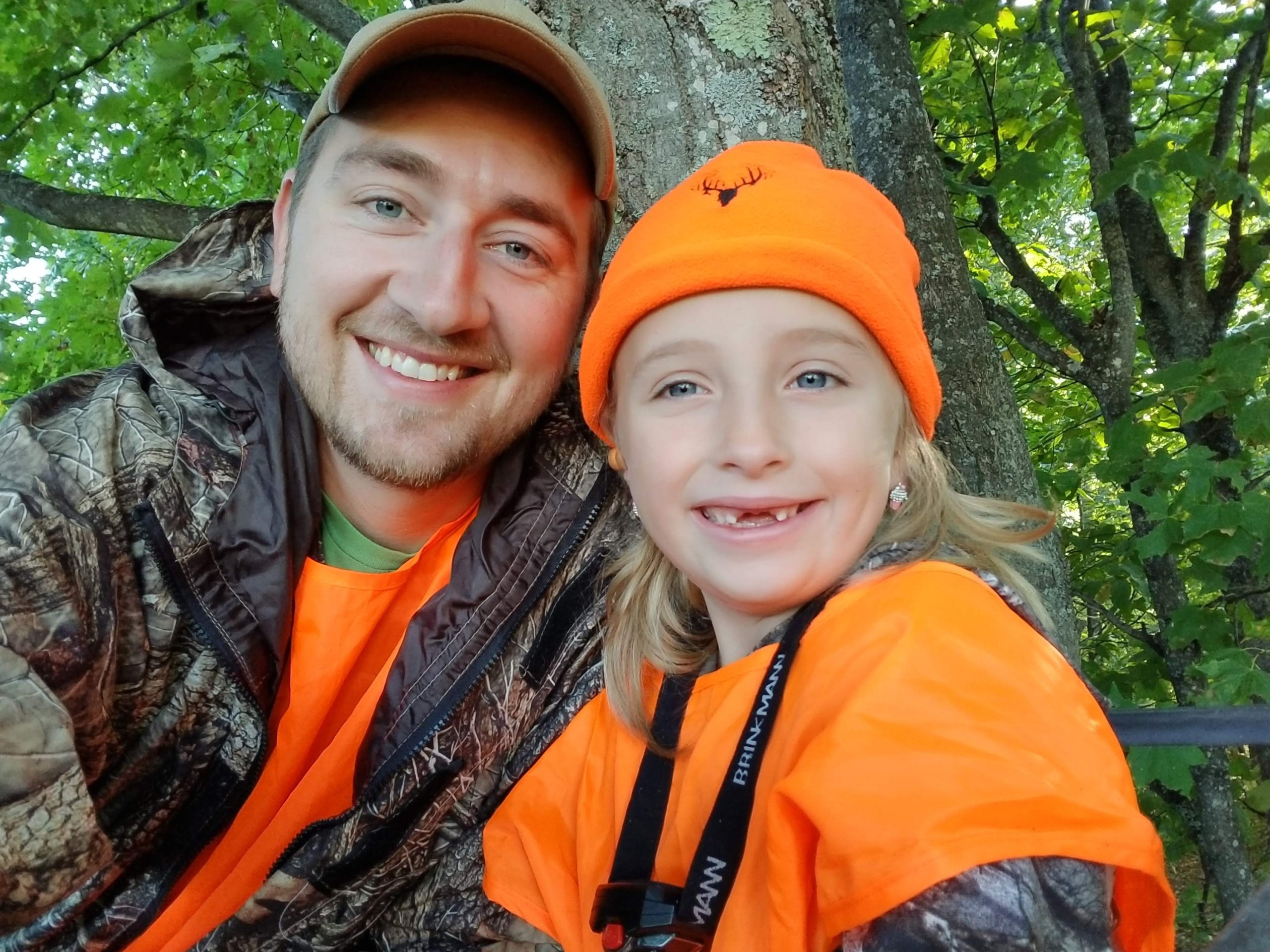
Featured Photo Caption: Graydon and Siella Steele decked in hunter’s orange for deer season. Photo courtesy of the Steele family.